(“Biodexa” or the “Company” or, together with its subsidiaries, the “Group”)
Preliminary Results for the Year Ended
For more information, please contact:
Tel: +44 (0)29 2048 0180
www.biodexapharma.com
About Biodexa
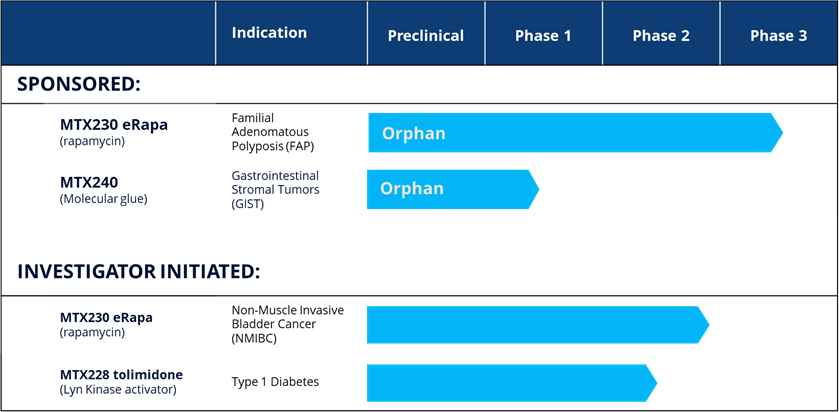
The Company’s lead development programs include eRapa, under development for Familial Adenomatous Polyposis and Non-Muscle Invasive Bladder Cancer, MTX240 under development for Gastrointestinal Stromal Tumors (GIST) and tolimidone, under development for the treatment of type 1 diabetes.
eRapa is a proprietary oral capsule formulation of rapamycin, also known as sirolimus. Rapamycin is an mTOR (mammalian Target Of Rapamycin) inhibitor. mTOR has been shown to have a significant role in the signaling pathway that regulates cellular metabolism, growth and proliferation and is activated during tumorigenesis.
MTX240 is a molecular glue, bringing two intracellular proteins, PDE3a and SLFN12, specifically co-expressed by GIST cancer cells, into close proximity to form a stable complex. This interaction stabilizes SLFN12, enabling it to drive RNase-mediated apoptosis in GIST cells through a mechanism independent of KIT signaling.
Tolimidone is an orally delivered, potent and selective inhibitor of
Biodexa’s headquarters and R&D facility is in
Forward-Looking Statements
Certain statements in this announcement may constitute “forward-looking statements” within the meaning of legislation in the
Reference should be made to those documents that Biodexa shall file from time to time or announcements that may be made by Biodexa in accordance with the rules and regulations promulgated by the
INTRODUCTION
Headquartered in
Until last year, the Company had been developing MTX110 for rare/orphan brain cancers but, due to resource constraints, these programs have been de-prioritized and removed from the R&D pipeline.
STRATEGY
The Company’s transition from a drug delivery company to a higher value therapeutics company was completed in 2025. With the in-licensing of MTX240 from
Our priorities for 2026 are as follows:
| Progress in 2025 | Priorities for 2026 | |
| Advance our development assets through the clinic | We announced the following clinical milestones in 2025: March: appointment of March: a successful Type C meeting with FDA, paving the way for the initiation of the Phase 3 Serenta trial in the US June: first patient enrolled in a Phase 2a study of tolimidone in T1D by the August: enrolment of the first US patient in the Phase 3 Serenta trial November: receipt of approval of Clinical Trial Application from EMA December: enrolment of the first European patient in the Phase 3 Serenta trial | Accelerate recruitment of our Phase 3 Serenta trial of eRapa in patients with FAP in the US and Continued engagement with FAP patient support groups in the US and Complete a bioavailability study of eRapa compared with Rapamune® Initiate a Phase 1b/2a dose escalation and extension study of MTX240 in GIST |
| Develop and broaden our drug development pipeline | We negotiated the in-license of MTX240 from Otsuka during the latter half of 2025 and signed the Licensing and Collaboration Agreement in early The US patent covering “oral rapamycin nanoparticle preparations and use” was issued in February | Appoint a contract manufacturer to manufacture clinical trial supplies for a Phase 1b/2a study of MTX240 in GIST and initiate a Phase 1b/2a study of MTX240 in GIST Initiate preclinical experiments to support additional potential, ideally orphan, indications for tolimidone Seek additional pre-IND and/or clinical-stage assets to acquire or in-license Expand further our patent portfolio to cover new inventions and divisionals to strengthen existing patent families |
| Secure long term, ideally non-dilutive financing for the Company | In May we announced our partner, Emtora Biosciences, had successfully secured an additional In December we announced a | Secure licensees and/or co-development partners for eRapa in Investigate other potential sources of long-term capital to support the Company’s development programs |
BUSINESS MODEL
Having successfully broadened our internal pipeline, our business model is to add value to our development programs by advancing them through the clinic before seeking partners to complete late-stage studies and commercialize the products.
Development
Our intention is to build a balanced portfolio of clinical-stage development assets, ideally with a focus on gastrointestinal and oncology indications. eRapa was in-licensed in
Manufacturing
We do not intend to establish our own manufacturing capabilities. For clinical trial supplies we utilize GMP-certified contract manufacturers.
Commercialization
Once proof-of-concept has been established, we intend to out-license our products to a partner who would complete the clinical development and subsequently market and sell them in the licensed territory. In addition to reimbursement of development costs, the partner would be expected to make milestone payments based on sales targets and royalty payments. Because the Phase 3 program for eRapa in FAP is substantially funded by a grant from CPRIT and an escrowed company match, commercialization of eRapa in FAP by the Company remains an option.
Our development pipeline now includes four projects, all which are at clinical stage, as follows:
CLINICAL-STAGE ASSETS
eRapa
eRapa is a proprietary oral capsule formulation of rapamycin, also known as sirolimus. Rapamycin is an mTOR (mammalian Target Of Rapamycin) inhibitor. mTOR has been shown to have a significant role in the signaling pathway that regulates cellular metabolism, growth and proliferation and is activated during tumorgenesis1. Rapamycin is approved in the US for organ rejection in renal transplantation as Rapamune® (Pfizer). Through the use of nanotechnology and pH sensitive polymers, eRapa is designed to address the poor bioavailability, variable pharmacokinetics and toxicity generally associated with the currently available forms of rapamycin.
Familial Adenomatous Polyposis (FAP)
FAP is characterized as a proliferation of polyps in the colon and/or rectum, usually occurring in mid-teenage years. There is no approved therapeutic option for treating FAP patients, for whom active surveillance and surgical resection of the colon and/or rectum remain the standard of care. If untreated, FAP typically leads to cancer of the colon and/or rectum. There is a significant hereditary component to FAP with a reported incidence of one in 5,000 to 10,000 in the US2 and one in 11,300 to 37,600 in
The results of the Phase 2 study were presented at two leading scientific conferences in the second quarter of 2024. Following a positive Type C meeting with the FDA, the protocol for a registrational Phase 3 trial was finalized. The Phase 3 trial, branded “Serenta”, is a multi-center, double-blind, placebo-controlled study in high risk patients diagnosed with FAP. The study plans to recruit 168 patients randomized 2:1 drug:placebo across 30 or more sites in the US and
Non-muscle Invasive Bladder Cancer (NMIBC)
NMIBC refers to tumors found in the tissue that lines the inner surface of the bladder. The most common treatment is transurethral resection of the bladder tumor followed by intravesical Bacillus Calmette-Guerin (“BCG”) with chemotherapy depending upon assessment of risk of recurrence. NMIBC is the fourth most common cancer in men with an incidence of 10.1 per 100,000 in men and 2.5 per 100,000 in women4. An ongoing double-blind, placebo-controlled Phase 2 Investigator Initiated Trial (“IIT”) in NMIBC is fully enrolled at 166 patients with primary endpoints of safety/tolerability and relapse free survival after 12 months of treatment. The Phase 2 study is supported by a
MTX240
MTX240, discovered by Otsuka and originally coded OPB-171775, is a novel molecular glue we intend to develop initially for the treatment of GIST. MTX240’s molecular glue activity brings together two intracellular proteins, PDE3A and SLFN12, specifically co-expressed by GIST cancer cells, into close proximity to form a stable complex. This interaction stabilizes SLFN12, enabling it to drive RNase-mediated apoptosis in GIST cells through a mechanism independent of KIT or PDGFR signaling. GIST is mostly driven by activating mutations in the KIT or PDGFR receptor tyrosine kinase. Although tyrosine kinase inhibitors (“TKIs”) such as imatinib, sunitinib, and regorafenib have significantly improved outcomes for GIST patients, resistance almost always develops through secondary KIT or PDGFR mutations or activation of alternative signaling pathways. This represents a substantial clinical challenge with limited therapeutic options for patients once they have cycled through the available TKIs. Molecular glue technology represents a novel approach that induces targeted protein interactions, offering a distinct mechanism of action to conventional tyrosine kinase inhibitors for GIST and by triggering cell death through an alternative MAPKinase pathway. MTX240 is designed to overcome the resistance mechanisms that render TKI-resistant GISTs refractory to conventional TKIs.
Gastrointestinal Stromal Tumors (GIST)
GIST is a rare gastrointestinal malignancy with approximately 6,000 diagnosed patients annually in the US5, with a significant unmet medical need for patients who develop TKI resistance. Approximately 10-15%. of GIST patients are either primarily refractory, or develop secondary resistance to available TKIs whereupon options for these patients remain limited.
The global GIST market is valued at approximately
GIST qualifies for orphan drug designation in major regulatory jurisdictions, offering potential regulatory advantages and incentives to support drug development.
Tolimidone
Tolimidone was originally discovered by Pfizer Inc. (“Pfizer”) and was developed through Phase 2 for the treatment of gastric ulcers. Pfizer undertook a broad pre-clinical program to characterize the pharmacology, pharmacokinetics, metabolism and toxicology of tolimidone. Pfizer discontinued development of the drug due to lack of efficacy for that indication in Phase 2a. Tolimidone is a selective activator of the enzyme
Type 1 Diabetes (T1D)
In T1D, the body’s immune system attacks pancreatic beta cells such that they can no longer produce insulin which is required to regulate plasma glucose levels. The causes of T1D are not fully understood and there is currently no cure. Patients with T1D are dependent on daily administration of insulin (via injection or infusion).
We are developing tolimidone for the treatment of T1D. As a
CHIEF EXECUTIVE’S REVIEW
Introduction
In 2025, our primary focus was the successful initiation of the Phase 3 Serenta trial of eRapa in FAP. Considerable effort was also expended on due diligence and negotiation of the Licensing and Collaboration Agreement for MTX240 which was signed in early
R&D update
eRapa
We in-licensed eRapa, a proprietary formulation of rapamycin, from
In
Also, in
Following initiation of the first US clinical site in
Other milestones achieved in 2025 included the receipt of Fast Track designation from FDA and Orphan Drug Designation from the EMA.
The Phase 3 study is expected to take approximately 18 months to recruit all 168 patients and database lock will occur after 75 events which is expected to be in the second half of 2029.
An ongoing double-blind, placebo-controlled Phase 2 IIT of eRapa in NMIBC has enrolled all 166 patients and is expected to read out in the third quarter of 2026.
MTX240
In
As a molecular glue, MTX240 has a unique mechanism of action compared with tyrosine kinase inhibitors, the current standard of care for GIST, all of which can eventually lose efficacy through continued mutation. MTX240’s novel mechanism may provide clinical benefit for a significant proportion of GIST patients, not only those who have developed resistance to TKIs. In patient derived xenograft (PDX) models, MTX240 has shown dose-dependent anti-tumor efficacy in imatinib and sunitinib resistant models irrespective of KIT mutation status.
MTX240 benefits from composition of matter patents in the US,
Our first step is to manufacture clinical trial supplies of MTX240 and then initiate an open-label Phase 1b/2a study by year-end. The study is expected to be in two parts: a standard dose escalation part to determine a maximum tolerated dose followed by an extension part. The extension part is likely to enroll patients with TKI-resistant GIST. By focusing on this high-need population, we are aiming to rapidly validate MTX240’s potential to treat patients who do not, or no longer, respond to the current standard of care.
Tolimidone
In
MTX110
Due to resource constraints, the MTX110 rare/orphan brain cancer programs were not funded in 2025 and, accordingly, have been removed from our development pipeline.
Financings
Promissory Note
In
Equity Line of Credit (ELOC)
In
CPRIT grant
In
Registered Offering
In
Further details of financings are included in “Financial Review”.
Outlook
Our primary focus for 2026 will be two-fold: first, continued acceleration of enrolment of patients in our registrational Phase 3 Serenta trial in the US and
As has been the case for the past few years, financing for small- and micro-cap biotech companies remains challenging. The
1 Tian et al., mTOR Signaling in Cancer and mTOR Inhibitors in Solid Tumor Targeting Therapy, Int J Mol Sci. 2019 Feb; 20(3): 755
2 www.rarediseases.org
3. www.orpha.net
- Cassell et al., World J Oncol. 2019 Jun; 10(3): 123–131
5 Zhu, H., et al. (2023). Update of epidemiology, survival and initial treatment in gastrointestinal stromal tumor: A population-based analysis. BMJ Open, 13(7), e072945. https://doi.org/10.1136/bmjopen-2023-072945
6 DataBridge Market Research. (2023). Gastrointestinal stromal tumor market size, trends and forecasts (2024-2032). Retrieved from https://www.databridgemarketresearch.com/reports/global-gastrointestinal-stromal-tumor-market
7 Medicina
FINANCIAL REVIEW
Introduction
Financial analysis
Key performance indicators
| 2025 | 2024 | Change | |
| R&D expenditure | £3.96m | £5.44m | (27.2)% |
| R&D as % of operating costs | 45% | 59% | n/a |
| Net cash inflow/(outflow) for the year | £6.87m | (£4.30m) | n/m |
| ============ | ============ | ============ | |
Revenue
Revenue for both periods was £Nil. The last of the Company’s R&D collaborations concluded in
Research and development expenditure
R&D costs analyzed by development project indication were as follows:
| Year ended 31 December | 2025 | 2024 | |
| £’000 | £’000 | ||
| MTX230 eRapa | |||
| Familial Adenomatous Polyposis (net of grant) | 1,338 | 1,627 | |
| Non-muscle Invasive Bladder Cancer | 154 | 284 | |
| Total eRapa | 1,492 | 1,911 | |
| MTX228 Tolimidone | |||
| Type 1 Diabetes | 383 | 1,093 | |
| Total tolimidone | 383 | 1,093 | |
| MTX110 (panobinostat) | |||
| Diffuse Midline Glioma | - | (6) | |
| Recurrent Glioblastoma | 36 | 635 | |
| Medulloblastoma | - | - | |
| Total MTX110 (panobinostat) | 36 | 629 | |
| Other preclinical | - | 102 | |
| R&D overheads | 2,050 | 1,702 | |
| Total R&D | 3,961 | 5,437 | |
MTX230 eRapa Familial Adenomatous Polyposis costs are shown above net of grant income. This is analyzed as follows:
| Year ended 31 December | 2025 | 2024 | |
| £’000 | £’000 | ||
| Grant income | (4,458) | (1,215) | |
| Gross costs | 5,796 | 2,842 | |
| Net charge to income statement | 1,338 | 1,627 | |
| % costs allocated against CPRIT grant | 77% | 43% | |
Research and development costs were £3.96 million, a reduction of £1.48 million, or 27% on 2024 (2024: £5.44 million). The percentage of R&D costs as a percentage of operating costs reduced to 45% from 59% in the prior year. The reduction in R&D costs in 2025 predominately reflects a reduction in spend of £0.71 million on pre-clinical studies and manufacturing costs on MTX228, £0.60 million on the MTX110 MAGIC-G1 study in rGBM and £0.44 million on MTX230 eRapa (net of CPRIT grant income). The percentage of MTX230 (eRapa) costs that were able to be offset against grant funding during the period was 77% compared to 43% in 2024. We anticipate that over the life of the grant this will be 67%.
Administrative costs
Administrative costs in the year increased by £1.04 million to £4.84 million (2024: £3.79 million), an increase of 27%. The increase in administrative costs in the year is driven by foreign exchange movement of £0.44 million, an increase in professional fees of £0.73 million offset by a reduction in share-based payments of £0.10 million.
In 2025 the Company expensed £1.72 million on legal and professional fees in connection with the successful financing transaction in December, the acquisition of the Otsuka license completed in 2026 and aborted acquisitions, and £0.37 million non- cash upfront commitment fee for the ELOC, this compares to £0.88m spent in 2024 on similar transactions.
Staff costs
During the year, the average number of staff decreased to 11 (2024: 13). Total staff cost increased 1% to £2.17 million (2024: £2.15 million), driven by the increase in wages and salaries of £0.14 million.
Finance income and expense
Finance income in 2025 and 2024 included gains in respect of an equity settled derivative financial liability of £2.30 million (2024: £3.22 million). The gains arose as a result of the fall in the Biodexa share price. In addition, the Company earned interest on cash deposits.
Finance expense in the 2024 and 2025 related to lease liabilities, discounted interest on deferred consideration and interest on the promissory note issued in
Taxation
During 2025 and 2024 we recognized
Capital expenditure
Purchase of tangible fixed assets in 2025 was £2,000 (2024: £0.01 million) and related to the purchase of IT equipment. During the year the Company took the decision to de-commission its laboratory in
Cash flow
Net cash outflow from operating activities in 2025 was £5.59 million (2024: outflow £12.26 million) driven by a net loss of £6.38 million (2024: loss £5.73 million) and after positive movements in working capital of £1.72 million (2024: negative £3.74 million), taxes received of £0.71 million (2024: £0.13 million), and other net negative adjustments for non-cash items totaling £1.63 million (2024: negative £2.93 million).
Investing activities outflow in 2025 of £0.58 million (2024: outflow of £0.60 million) included purchases of property, plant and equipment of £2,000 (2024: £0.01 million) and payment of deferred consideration on the eRapa license of £0.69 million (2024: £0.77 million). These cash outflows are offset by interest income from bank deposits of £0.09 million (2024: £0.18 million).
Financing activities inflow in 2025 of £13.04 million (2024: inflow of £8.56 million) was driven by receipts from share issues of £13.75 million (2024: £8.31 million) from use of the ELOC agreement, proceeds from the warrant inducement in
As a result of the foregoing, net cash inflow for the year was £6.87 million (2024: outflow of £4.30 million).
Change in ADS Ratio and Nominal Value of Ordinary Shares
On
At a General Meeting on
On
Financings
Equity Line of Credit (“ELOC”)
In
We may direct
Warrant Inducement
In
Registered Offering
In
Promissory Note
The promissory note issued in
CPRIT Grant
In
Going Concern – material uncertainty
The Group’s future viability is dependent on its ability to raise cash from financing activities to finance its development plans until milestones and/or royalties can be secured from partnering the Company’s assets. The Group’s failure to raise capital as and when needed could have a negative impact on its financial condition and ability to pursue its business strategies.
The Directors believe there are adequate options and time available to secure additional financing for the Company and after considering the uncertainties, the Directors consider it is appropriate to continue to adopt the going concern basis in preparing these financial statements. The Group's consolidated financial statements have therefore been presented on a going concern basis, which contemplates the realization of assets and the satisfaction of liabilities in the normal course of business.
As at
In the Directors’ opinion, the environment for financing of small and micro-cap biotech companies remains challenging. While this may present acquisition and/or merger opportunities with other companies with limited or no access to financing, as noted above, any attendant financings by Biodexa are likely to be dilutive. The Directors continue to evaluate financing options, including those connected to acquisitions and/or mergers, potentially available to the Group. Any alternatives considered are contingent upon the agreement of counterparties and accordingly, there can be no assurance that any alternative courses of action to finance the Company would be successful.
This requirement for additional financing in the short term represents a material uncertainty that may cast significant doubt upon the Group and Parent Company’s ability to continue as a going concern. Should it become evident in the future that there are no realistic financing options available to the Company which are actionable before its cash resources run out then the Company will no longer be a going concern. In such circumstances, we would no longer be able to prepare financial statements under paragraph 25 of IAS 1. Instead, the financial statements would be prepared on a liquidation basis and assets would be stated at net realizable value and all liabilities would be accelerated to current liabilities.
Environmental matters, community, human rights issues and employees
As at
The Company strives to be an equal opportunity employer, irrespective of race or gender. At
Annual greenhouse gas emissions
We measure our environmental performance by reporting our carbon footprint in terms of tonne CO2 equivalent. We report separately on our indirect emissions from consumption of electricity (Scope 2) and emissions consisting of employee travel in cars on Group business estimated on the basis of miles travelled (Scope 3). The Group have elected to monitor and report its energy efficiency using tonnes of CO2 per employee as an intensity ratio.
Methodology
In calculating the reported energy usage and equivalent greenhouse gas emissions the Group have referred to the HM Government Environment Reporting Guidelines and the GHG Reporting Protocol. A location-based allocation methodology was used to calculate electricity usage.
| Tonnes CO2e | 2025 | 2024 |
| Scope 2 | 10 | 17 |
| Scope 3 | 1 | 3 |
| Total | 12 | 20 |
| Intensity ratio (tonnes of CO2 per employee) | 1.1 | 0.9 |
The Group’s electricity costs for 2025 were approximately £16,000 (2024: £25,000). The kWh usage in the year was 54,380 (2024: 81,933). The Group has no immediate plans to improve energy efficiency.
CONSOLIDATED STATEMENTS OF COMPREHENSIVE INCOME
For the year ended 31 December
| Note | 2025 £’000 | 2024 £’000 | 2023 £’000 | |
| Revenue | – | – | 381 | |
| Other income | 152 | 31 | 14 | |
| Research and development costs | (3,961) | (5,437) | (4,067) | |
| Administrative costs | (4,836) | (3,793) | (4,342) | |
| Loss from operations | (8,645) | (9,199) | (8,014) | |
| Finance income | 2 | 2,385 | 3,385 | 570 |
| Finance expense | 2 | (229) | (165) | (41) |
| Loss before tax | (6,489) | (5,979) | (7,485) | |
| Taxation | 105 | 250 | 406 | |
| Loss for the year attributable to the owners of the parent | (6,384) | (5,729) | (7,079) | |
| Other comprehensive income: | ||||
| Items that will or may be reclassified subsequently to profit or loss: | ||||
| Exchange gains arising on translation of foreign operations | 3 | – | – | |
| Total other comprehensive income net of tax | 3 | – | – | |
| Total comprehensive loss attributable to the owners of the parent | (6,381) | (5,729) | (7,079) | |
| Loss per share | ||||
| Continuing operations | ||||
| Basic and diluted loss per ordinary share - pence | 3 | (0.01)p | (0.1)p | (2)p |
The notes form an integral part of these consolidated financial statements.
CONSOLIDATED STATEMENTS OF FINANCIAL POSITION
At 31 December
| Company number 09216368 | Note | 2025 £’000 | 2024 £’000 | 2023 £’000 |
| Assets | ||||
| Non-current assets | ||||
| Property, plant and equipment | 91 | 324 | 571 | |
| Intangible assets | 5,645 | 5,646 | 2,941 | |
| 5,736 | 5,970 | 3,512 | ||
| Current assets | ||||
| Trade and other receivables | 3,786 | 6,568 | 637 | |
| Current taxation receivable | 123 | 573 | 422 | |
| Cash and cash equivalents | 8,534 | 1,669 | 5,971 | |
| 12,443 | 8,810 | 7,030 | ||
| Total assets | 18,179 | 14,780 | 10,542 | |
| Liabilities | ||||
| Non-current liabilities | ||||
| Deferred consideration | 645 | 1,306 | – | |
| Borrowings | - | 118 | 295 | |
| 645 | 1,424 | 295 | ||
| Current liabilities | ||||
| Trade and other payables | 2,590 | 3,504 | 1,240 | |
| Deferred consideration | 563 | 538 | – | |
| Borrowings | 61 | 609 | 169 | |
| Provisions | - | – | – | |
| Derivative financial liability | 2,915 | 383 | 4,160 | |
| 6,129 | 5,034 | 5,569 | ||
| Total liabilities | 6,774 | 6,458 | 5,864 |
| CONSOLIDATED STATEMENTS OF FINANCIAL POSITION(CONTINUED) At 31 December | ||||
| Note | 2025 £’000 | 2024 £’000 | 2023 £’000 | |
| Issued capital and reserves attributable to owners of the parent | ||||
| Share capital | 14,099 | 11,725 | 6,253 | |
| Share premium | 98,923 | 93,124 | 86,732 | |
| Merger reserve | 53,003 | 53,003 | 53,003 | |
| Warrant reserve | 1,185 | 894 | 3,457 | |
| Foreign exchange reserve | 3 | – | – | |
| Accumulated deficit | (155,808) | (150,424) | (144,767) | |
| Total equity | 11,405 | 8,322 | 4,678 | |
| Total equity and liabilities | 18,179 | 14,780 | 10,542 | |
The notes form an integral part of these consolidated financial statements.
CONSOLIDATED STATEMENTS OF CASH FLOWS
For the year ended 31 December
| Note | 2025 £’000 | 2024 £’000 | 2023 £’000 | |
| Cash flows from operating activities | ||||
| Loss for the year | (6,384) | (5,729) | (7,079) | |
| Adjustments for: | ||||
| Depreciation of property, plant and equipment | 52 | 117 | 143 | |
| Depreciation of right of use asset | 136 | 135 | 137 | |
| Amortisation of intangible fixed assets | 1 | 2 | 3 | |
| Loss on disposal of property, plant and equipment | 29 | 4 | 2 | |
| Impairment of loan | - | – | 79 | |
| Impairment of ELOC upfront fee | 373 | - | - | |
| Finance income | (2,385) | (3,385) | (570) | |
| Finance expense | 229 | 165 | 41 | |
| Share-based payment charge | 170 | 283 | 28 | |
| Taxation | (105) | (250) | (406) | |
| Foreign exchange losses/(gains) | (130) | 4 | – | |
| Cash flows from operating activities before changes in working capital | (8,014) | (8,654) | (7,622) | |
| Decrease/(Increase) in trade and other receivables | 2,629 | (5,975) | 365 | |
| (Decrease)/Increase in trade and other payables | (913) | 2,239 | (207) | |
| (Decrease)/Increase in provisions | - | – | (207) | |
| Cash used in operations | (6,298) | (12,390) | (7,671) | |
| Taxes received | 707 | 129 | 845 | |
| Net cash used in operating activities | (5,591) | (12,261) | (6,826) |
CONSOLIDATED STATEMENTS OF CASH FLOWS(CONTINUED)
For the year ended 31 December
| Note | 2025 £’000 | 2024 £’000 | 2023 £’000 | |
| Investing activities | ||||
| Purchases of property, plant and equipment | (2) | (9) | (26) | |
| Proceeds from disposal of fixed assets | 18 | – | 4 | |
| Purchase of intangible asset/deferred consideration | (689) | (765) | (237) | |
| Loan granted | - | – | (79) | |
| Interest received | 90 | 176 | 73 | |
| Net cash (used in)/generated from investing activities | (583) | (598) | (265) | |
| Financing activities | ||||
| Interest paid | (14) | – | (13) | |
| Amounts paid on lease liabilities | (246) | (186) | (188) | |
| (Repayment)/Proceeds from promissory note | (450) | 431 | – | |
| Share issues including warrants, net of costs | 13,749 | 8,312 | 10,427 | |
| Net cash generated from financing activities | 13,039 | 8,557 | 10,226 | |
| Net increase/(decrease) in cash and cash equivalents | 6,865 | (4,302) | 3,135 | |
| Cash and cash equivalents at beginning of year | 1,669 | 5,971 | 2,836 | |
| Exchange (losses)/gains on cash and cash equivalents | - | – | – | |
| Cash and cash equivalents at end of year | 8,534 | 1,669 | 5,971 |
The notes form an integral part of these consolidated financial statements.
CONSOLIDATED STATEMENTS OF CHANGES IN EQUITY
For the year ended 31 December
| Note | Share capital £’000 | Share premium £’000 | Merger reserve £’000 | Warrant reserve £’000 | Foreign exchange reserve £’000 | Accumulated deficit £’000 | Total equity £’000 | |
| At | 11,725 | 93,124 | 53,003 | 894 | – | (150,424) | 8,322 | |
| Loss for the year | – | – | – | – | – | (6,384) | (6,384) | |
| Foreign exchange translation | – | – | – | – | 3 | – | 3 | |
| Total comprehensive loss | – | – | – | – | 3 | (6,384) | (6,381) | |
| Transactions with owners | ||||||||
| Shares issued under ELOC agreement | 2,030 | 4,817 | – | – | – | – | 6,847 | |
| Costs associated with ELOC agreement | 86 | (77) | – | – | – | – | 9 | |
| Shares issued on | 100 | 143 | – | – | – | – | 243 | |
| Costs associated with share issue on | – | (8) | – | – | – | – | (8) | |
| Shares issued | 158 | 1,110 | – | 1,184 | – | – | 2,452 | |
| Costs associated with share issue on | – | (186) | – | (173) | – | – | (359) | |
| Lapse warrants | – | – | – | (720) | – | 720 | – | |
| Share-based payment charge | – | – | – | – | – | 280 | 280 | |
| Total contribution by and distributions to owners | 2,374 | 5,799 | 291 | 1,000 | 9,464 | |||
| At | 14,099 | 98,923 | 53,003 | 1,185 | 3 | (155,674) | 11,405 |
CONSOLIDATED STATEMENTS OF CHANGES IN EQUITY(CONTINUED)
| Note | Share capital £’000 | Share premium £’000 | Merger reserve £’000 | Warrant reserve £’000 | Accumulated deficit £’000 | Total equity £’000 | |
| At | 6,253 | 86,732 | 53,003 | 3,457 | (144,767) | 4,678 | |
| Loss for the year | – | – | – | – | (5,729) | (5,729) | |
| Total comprehensive loss | – | – | – | – | (5,729) | (5,729) | |
| Transactions with owners | |||||||
| Shares issued on | 1,614 | 5,048 | – | – | – | 6,662 | |
| Costs associated with share issue on | – | (487) | – | – | – | (487) | |
| Shares issued on | 2,105 | 79 | – | 2 | – | 2,186 | |
| Costs associated with share issue on | – | (55) | – | – | (297) | (352) | |
| Exercise of warrants during the year | 1,602 | 1,739 | – | (2,565) | – | 776 | |
| Issue of shares to purchase intangible asset | 151 | 68 | – | – | – | 219 | |
| Share-based payment charge | – | – | – | – | 369 | 369 | |
| Total contribution by and distributions to owners | 5,472 | 6,392 | – | (2,563) | 72 | 9,373 | |
| At | 11,725 | 93,124 | 53,003 | 894 | (150,424) | 8,322 |
NOTES FORMING PART OF THE FINANCIAL STATEMENTS
For the year ended
1. Basis of preparation
The consolidated financial statements have been prepared in accordance with international accounting standards in conformity with the requirements of the Companies Act 2006, and they are prepared in accordance with international financial reporting standards. The consolidated financial statements have been prepared on a historical cost basis except that the following assets and liabilities are stated at their fair value: certain financial assets and financial liabilities measured at fair value, and liabilities for cash-settled share-based payments.
The financial information contained in this final announcement does not constitute statutory financial statements as defined in Section 435 of the Companies Act 2006. The financial information has been extracted from the financial statements for the year ended
The financial statements for 2024 and 2023 have been delivered to the Registrar of Companies and the 2025 financial statements will be delivered after the Annual General Meeting.
The auditor’s report for the Company’s 2025 Annual Report and Accounts was unqualified but did draw attention to the material uncertainty relating to going concern. The auditor’s report did not contain statements under s498(2) or (3) of the Companies Act 2006.
Whilst the financial information included in this results announcement has been prepared in accordance with International Financial Reporting Standards (IFRSs) this announcement does not itself contain sufficient information to comply with IFRSs. The information in this results announcement was approved by the board on
Going concern – material uncertainty
The Group’s future viability is dependent on its ability to raise cash from financing activities to finance its development plans until milestones and/or royalties can be secured from partnering the Company’s assets. The Group’s failure to raise capital as and when needed could have a negative impact on its financial condition and ability to pursue its business strategies.
The Directors believe there are adequate options and time available to secure additional financing for the Company and after considering the uncertainties, the Directors consider it is appropriate to continue to adopt the going concern basis in preparing these financial statements. The Group's consolidated financial statements have therefore been presented on a going concern basis, which contemplates the realisation of assets and the satisfaction of liabilities in the normal course of business.
As at
In the Directors’ opinion, the environment for financing of small and micro-cap biotech companies remains challenging. While this may present acquisition and/or merger opportunities with other companies with limited or no access to financing, as noted above, any attendant financings by Biodexa are likely to be dilutive. The Directors continue to evaluate financing options, including those connected to acquisitions and/or mergers, potentially available to the Group. Any alternatives considered are contingent upon the agreement of counterparties and accordingly, there can be no assurance that any alternative courses of action to finance the Company would be successful.
This requirement for additional financing in the short term represents a material uncertainty that may cast significant doubt upon the Group and Parent Company’s ability to continue as a going concern. Should it become evident in the future that there are no realistic financing options available to the Company which are actionable before its cash resources run out then the Company will no longer be a going concern. In such circumstances, we would no longer be able to prepare financial statements under paragraph 25 of IAS 1. Instead, the financial statements would be prepared on a liquidation basis and assets would be stated at net realizable value and all liabilities would be accelerated to current liabilities.
Accounting for rRapa and CPRIT grant
On
A jointly controlled escrow account was established on completion of the LCA. FAP program transactions eligible to be allocated against the CPRIT grant and match funding are processed through the escrow account, including the Company’s deposits of matching funds, as set out in the agreement, the receipt of grant funding from CPRIT and the payment of eligible R&D expenses. Although the CPRIT grant and R&D supplier contracts are with Emtora, the joint arrangement nature of the LCA results in Emtora being deemed to be acting as the Company’s agent. Accordingly, the Company recognises 100% of the grant and 100% of the R&D expenditure. The CPRIT grant recognised is on a 1 for 2 match basis for the first
The balances as at 31 December were as follows in relation to the FAP project:
£’000 | £’000 | |
| Prepayments* | 2,842 | 6,114 |
| Deferred revenue | 571 | 1,468 |
* prepayment reflects only the escrow account balance
2. Finance income and expense
| 2025 £’000 | 2024 £’000 | 2023 £’000 | |
| Finance income | |||
| Interest received on bank deposits | 83 | 166 | 73 |
| Other interest receivable | 6 | 1 | 10 |
| Gain on equity settled derivative financial liability | 2,296 | 3,218 | 487 |
| Total finance income | 2,385 | 3,385 | 570 |
| 2025 £’000 | 2024 £’000 | 2023 £’000 | |
| Finance expense | |||
| Interest expense on lease liabilities | 10 | 19 | 28 |
| Interest expense on deferred consideration | 159 | 144 | – |
| Other loans | 60 | 2 | 13 |
| Total finance expense | 229 | 165 | 41 |
3. Loss per share
| 2025 £’000 | 2024 £’000 | 2023 £’000 | |
| Numerator | |||
| Loss used in basic EPS and diluted EPS: | |||
| Continuing operations | (6,384) | (5,729) | (7,079) |
| Denominator | |||
| Weighted average number of ordinary shares used in basic EPS: | 54,861,066,264 | 4,952,784,179 | 315,849,600 |
| Basic and diluted loss per share: | |||
| Continuing operations – pence | (0.01)p | (0.1)p | (2)p |
At a General Meeting on
During the year the Company issued warrants that were accounted through the Warrant Reserve.
The Company has considered the guidance set out in IAS 33 in calculating the denominator in connection with the issuance of Pre-Funded warrants. Management have recognised the warrants from the date of grant rather than the date of issue of the corresponding Ordinary Shares when calculating the denominator.
The Group has made a loss in the current and previous periods presented, and therefore the options and warrants are anti-dilutive. As a result, diluted loss per share is presented on the same basis as basic loss per share.
4. Share capital
| Authorised, allotted and fully paid – classified as equity | 2025 Number | 2025 £ | 2024 Number | 2024 £ | 2023 Number | 2023 £ |
| At 31 December | ||||||
| Ordinary shares of £0.000001 each | 225,817,808,922 | 225,818 | 6,685,918,922 | 334,296 | 1,189,577,722 | 1,189,578 |
| ‘A’ Deferred shares of £1 each | 1,000,001 | 1,000,001 | 1,000,001 | 1,000,001 | 1,000,001 | 1,000,001 |
| ‘B’ Deferred shares of £0.001 each | 4,063,321,418 | 4,063,321 | 4,063,321,418 | 4,063,321 | 4,063,321,418 | 4,063,321 |
| ‘C’ Deferred shares of £0.00005 each | 126,547,389,518 | 6,327,370 | 126,547,389,518 | 6,327,370 | – | – |
| ‘D’ Deferred shares of £0.000001 each | 2,482,747,137,178 | 2,482,747 | – | – | – | – |
| Total | 14,099,257 | 11,724,988 | 6,252,900 |
At a General Meeting on
On
In accordance with the Articles of
5. Related party transactions
The Directors consider there to be no related party transactions during the periods reported other than Directors Remuneration.
6. Events after the reporting date
On
Pursuant to the License Agreement, the Company will be responsible for all development, manufacturing and commercialization activities for MTX240 in the Licensed Territory, and Otsuka will retain all rights to MTX240 in
On