Upcoming Earnings
Tech and Retail Take Center Stage as Earnings Parade Rolls On
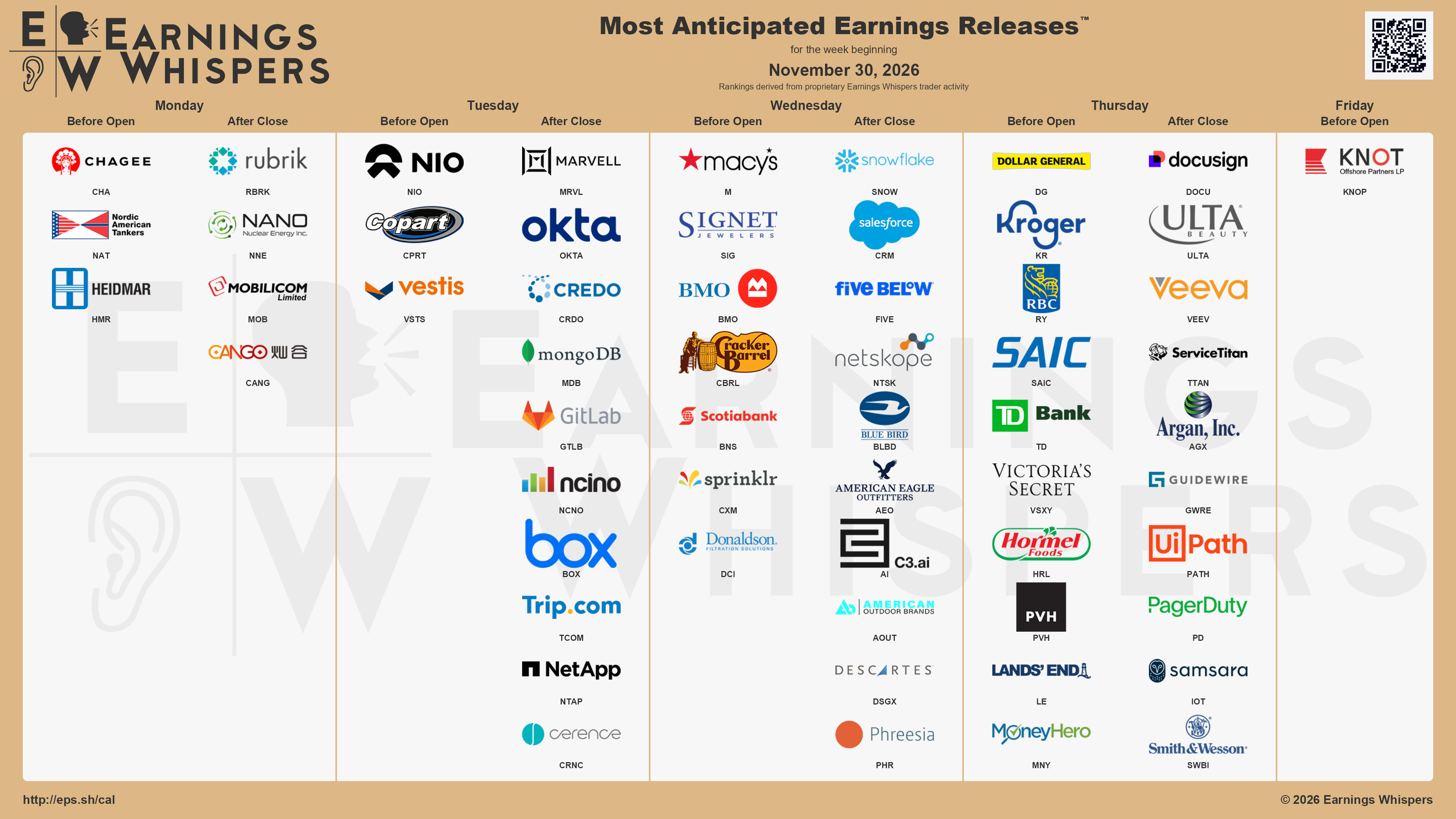
This week's earnings calendar reads like a who's who of the stocks everyone loves to argue about at the dinner table. The technology crowd is hogging the spotlight, and the mood is decidedly split. Salesforce, Marvell, and Snowflake are walking in with a chill in the air, as the smart money seems skeptical these giants can wow a crowd that has grown harder to impress. Snowflake in particular has a lot to prove after cooling off since its last report. On the brighter side, Okta is getting love from the bulls, and NetApp is strutting in with genuine swagger after stringing together a nice run. Expect fireworks either way, since names like MongoDB and Rubrik have a habit of swinging wildly the moment the numbers hit, so traders are bracing for some white-knuckle sessions.
Retail and the dinner-and-shopping crowd offer a friendlier storyline, which is fitting with the holidays bearing down on us. Dollar General and Kroger look like the steady hands of the bunch, with upbeat vibes suggesting shoppers are still filling their carts even while pinching pennies. Victoria's Secret and American Outdoor Brands are quietly generating buzz, and even Cracker Barrel could surprise after a rocky stretch. The big banks up north, including Royal Bank of Canada, Toronto-Dominion, and Bank of Nova Scotia, round things out as the dependable blue-chip bookends, rarely prone to drama but worth watching for clues about the broader economy. The wild cards remain the smaller, more volatile players like Canadian Solar and ChargePoint, where expectations are muted and the potential for a jolt is high. All told, it is a feast for anyone who likes their market news with a side of suspense.
Marvell's AI Rocket Keeps Climbing, But Bears Are Circling
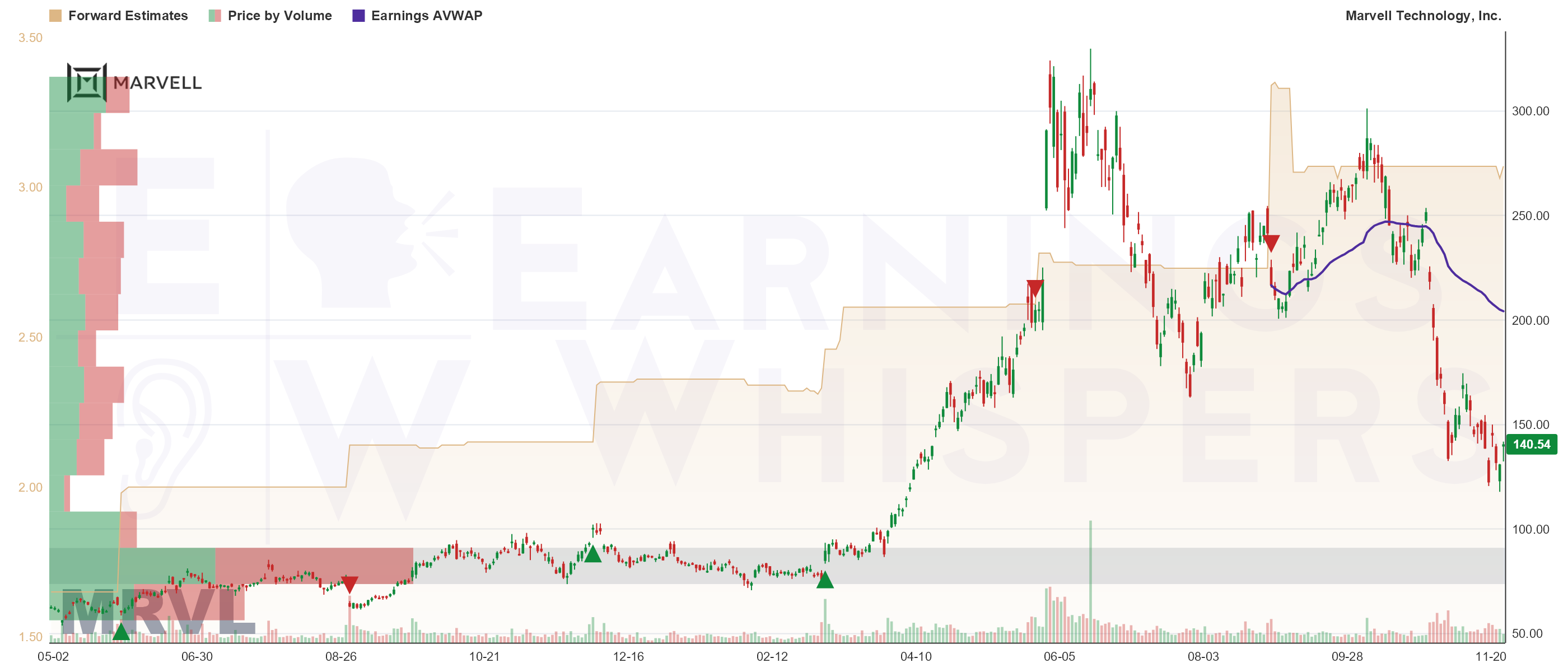
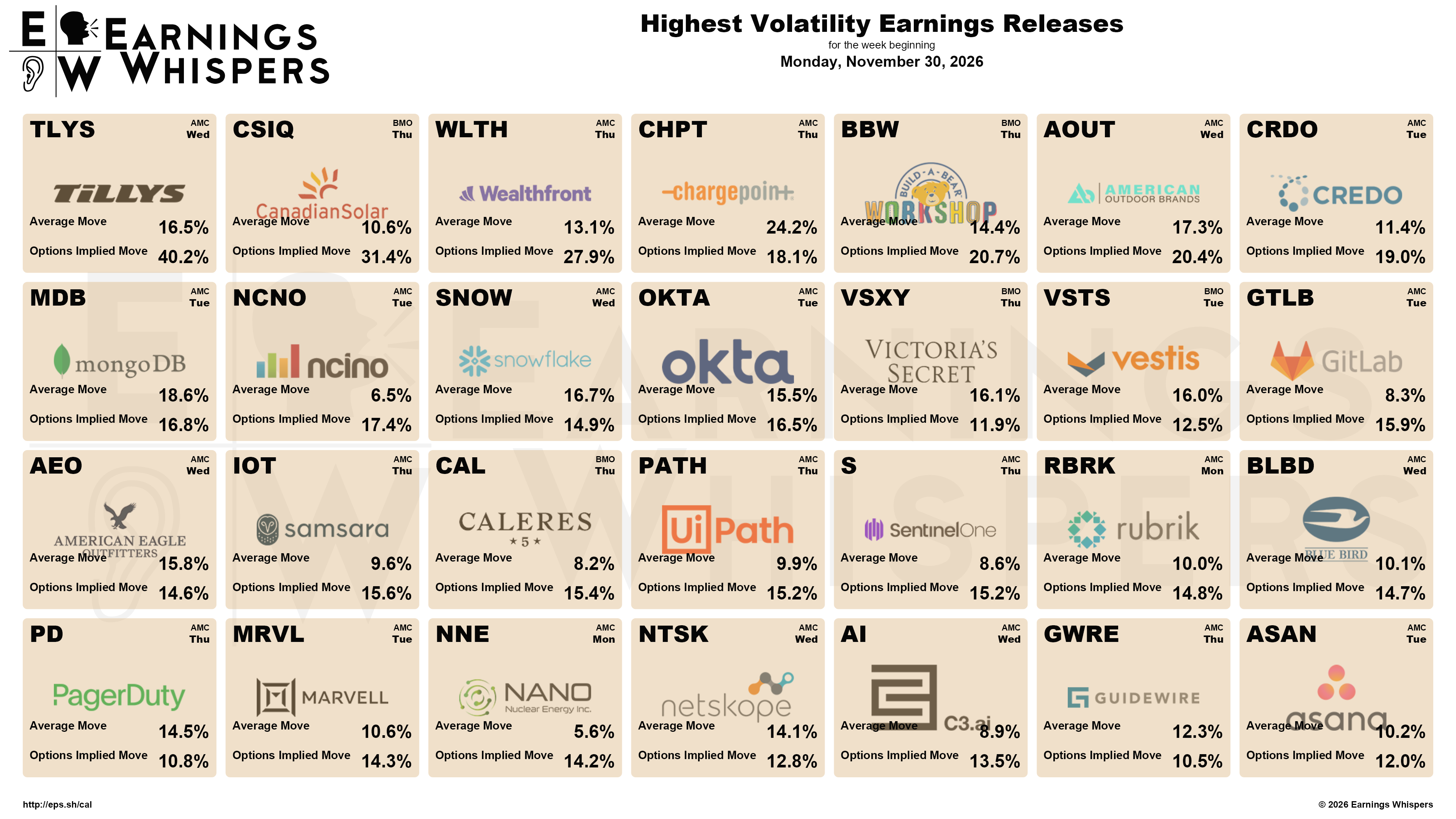
Marvell Technology (MRVL) is set to report earnings on Tuesday, December 1, 2026 at about 4:05 PM ET. Wall Street is looking for $1.10 per share on revenue of $3.16 billion, a hefty 52.3% jump from a year ago, while the Earnings Whisper number sits a touch higher at $1.14. That lands right in the fat part of management's own guidance of $1.05 to $1.15 per share on $2.99 billion to $3.31 billion in sales. Here is the odd part: investors are actually bearish heading in, yet 84.6% still expect a beat. Short sellers have piled on, with short interest up 15.3% since last quarter, and the stock has been in a rough patch, sliding 37.6% from where it opened after the last report and now sitting 25.7% below its 200 day average of $189.17. Still, analysts have been nudging their estimates higher. Option traders are bracing for a 14.3% swing, bigger than the 10.6% average move lately, and on Friday, November 13, there was chunky buying of 16,069 of the $220 calls and 13,829 of the $145 puts expiring January 15, meaning folks are placing big bets in both directions.
Here is why the bearish mood feels out of step with the story. Last quarter Marvell raised its full year revenue target again to roughly $12 billion, the latest in a steady string of hikes, and bumped next year's growth outlook to about 50% even off a bigger base. The headline grabber was a massive expanded deal and warrant with a major hyperscaler in the Google TPU world, framed at around $120 billion in potential revenue over about six and a half years. Custom silicon is expected to more than double next year, operating margins are climbing toward the 38 to 40% target, and the optics business got a big upgrade. The watch items are minor by comparison: the comms segment is lumpy and guided lower near term, custom work is pinching gross margins a bit, and there is a CFO changeover to digest. Net read, the engine is running hot and the bears may be fighting the wrong tape.
Okta Heads Into Earnings Hot, With AI Still Waiting in the Wings
Okta (OKTA) steps up to the plate Tuesday, December 1, 2026 at around 4:00 PM ET. Wall Street is looking for $0.93 per share on $815.52 million in revenue, which would be 9.9% growth from a year ago, but the Earnings Whisper number is a loftier $1.03. Management told us to expect $0.92 to $0.94 per share on revenue between $813 million and $817 million, so they left themselves a little wiggle room to shine. The crowd is feeling good, with 85.7% betting on a beat. Short sellers nudged up their positions by 4.7% since last quarter, yet the stock has shrugged them off and climbed 24.9% since the last report, now sitting a towering 55.1% above its 200 day average of $133.76. Estimates have been drifting higher, option traders are bracing for a 16.5% swing (the stock has averaged a 15.5% jump lately), and on November 11 someone scooped up 2,025 of the $150 puts expiring February 19, 2027, which is worth keeping one eye on.
Here is the real story heading in. Okta is genuinely speeding up, not just coasting. Last quarter they bumped their full-year growth guide to 10-11%, raised free cash flow margins, and guided future bookings higher, all driven by the boring but beautiful core business: big enterprise deals, new products now making up about 30% of bookings, and partner-sourced wins. Customers paying over a million bucks a year grew more than 20% to over 600. The flashy AI and agentic identity stuff (the Permiso buy, the Anthropic partnership, the government IL-5 clearance) is piling up deals but is still too small to move the numbers, so think of it as a lottery ticket for 2028, not a check that clears today. Watch the bookings and the forward guide. If those keep accelerating, the bulls stay happy even before AI ever shows up on the scoreboard.
Snowflake Heads Into Earnings With AI Firing on All Cylinders
Snowflake (SNOW) is set to report earnings after the closing bell on Wednesday, December 2, 2026 at about 4:05 PM ET. Wall Street is looking for $0.60 per share on revenue of $1.65 billion, which would be a healthy 36.0% jump from a year ago, but the whisper number is running hotter at $0.67 per share. That tops the company's own guidance of around $1.59 billion. The crowd is feeling good here, with 88.2% expecting a beat. Short sellers have backed off by 6.7% since last quarter, yet the stock has slid 26.8% from where it opened after the last report, leaving it 12.1% above its 200 day average of $246.54. Analysts have been nudging their estimates higher. Options traders are bracing for a big 14.9% swing, roughly in line with the 16.7% average move of recent quarters, and on Monday, November 16, someone scooped up 3,511 of the $320.00 calls expiring December 18, a clear bet that the fireworks point up.
The story going in is simple: AI has stopped being a science project and become a real growth engine. Last quarter product revenue grew 37%, the third straight pickup, and management raised its full-year outlook yet again while profit margins climbed to 15%. Their AI tools are spreading fast, with Coco now in more than 9,100 accounts and the newer CoWork product already landing in 5,800. Even better, the plain old core business is speeding back up too. The one wrinkle to watch is gross margin, trimmed slightly to 74% because those AI workloads cost more to run, but that is a good problem born of demand, not weakness. If the core keeps re-accelerating alongside AI, the recent slide in the stock may start to look like a gift.
Credo's Rocket Ride Meets a Nervous Crowd
Credo Technology Group Holding (CRDO) steps up to the plate after the close on Tuesday, December 1, 2026 at roughly 4:05 PM ET. Wall Street is looking for $1.29 per share on $530.04 million in revenue, which would be a jaw-dropping 97.8% jump from a year ago, though the whisper number is a touch higher at $1.39. Management itself guided to $525 to $535 million, so they are playing in the same ballpark. Here is the odd part: investors are bearish heading in, yet 68.8% still expect a beat. Short sellers have piled on, with short interest up 43.7% since last quarter, and the stock has tumbled 38.7% from where it opened after the last report, leaving it a stunning 36.0% below its 200 day average of $180.54. Still, estimates have been drifting higher, not lower. Option traders are bracing for a 19.0% swing, bigger than the 11.4% average move of late, and on Friday someone scooped up 4,138 of the $140 calls expiring in October 2027, a sizable bet that the gloom is overdone.
The story under the hood is all about optics finally becoming a real second engine. Last quarter Credo raised its full-year growth guide yet again, to over 85%, posted a record quarter, and recognized its first silicon photonics revenue after the Dust Photonics deal. New wins keep stacking up, from joining the OpenCPX consortium to design wins ramping in 2028 and 1.6T chips landing later this year. The catch is that the back half of the year leans heavily on an unproven optics ramp, gross margins are flat rather than climbing, and cash dropped from $1.4 billion to $764 million after the Dust buyout. Two customers still make up more than half of sales. So the engine is roaring, but the market clearly wants proof the second half delivers before it climbs back on board.
MongoDB Heads Into Earnings Hot, But the Stock Didn't Get the Memo
MongoDB (MDB) steps up to the plate after the close on Tuesday, December 1, 2026, at roughly 4:05 PM ET. Wall Street wants $1.60 per share on $759.63 million in revenue, which would be a tidy 20.9% jump from a year ago, but the whisper number is running hotter at $1.79. Management penciled in $1.57 to $1.61 per share on $756 to $761 million. The crowd is feeling good here, with 83.3% betting on a beat, and short sellers have backed off by 5.5% since last quarter. Still, the stock has quietly slid 15.6% since its last earnings pop and now sits 3.7% under its 200 day average of $332.26. Analysts have nudged estimates higher. Options traders are bracing for a 16.8% swing, roughly in line with the 18.6% average lately, and someone made a bold long-term bet on Friday, November 13, scooping up 3,414 of the $600 calls that expire in December 2028.
Here is the real story: last quarter was a barnburner. Total revenue growth sped up to 30%, the fastest since fiscal 2024, and management raised guidance on basically every line, lifting the Atlas growth outlook by 300 basis points and pushing margins up. The surprise star was the self-managed EA business, posting its first double-digit full-year growth in three years after search and vector search launched there. Add in a fresh Anthropic partnership plugging Claude into the mix, AI shops shifting workloads off Postgres onto Atlas, and Voyage customer counts nearly doubling for a second straight quarter, and you have real momentum. The one nitpick is a cautious fourth-quarter Atlas setup, which management chalks up to being conservative rather than any actual slowdown. With a cheaper stock and raised numbers, this one is worth watching closely.
Salesforce: The AI Agents Are Actually Selling Now
Salesforce reports after the bell on Wednesday, December 2, 2026, and Wall Street wants $3.43 a share on $11.46 billion in sales, which would be about 11.7% more revenue than a year ago. The quiet number the pros whisper about is a bit higher at $3.65, and the company itself guided to $3.42 to $3.44 on $11.42 to $11.50 billion. Here is the funny part: investors are walking in grumpy and bearish, yet 72.7% of them still expect a beat. Short sellers have backed off, cutting their bets by 16.4% since last quarter, while the stock has slid 13.8% from where it opened after the last report and now sits a hair (0.2%) above its 200 day average of $197.75. Analysts have been nudging estimates higher, option traders are bracing for a roughly 11% swing even though the stock usually moves about 6.5%, and on November 17 someone scooped up 14,279 of the $150 puts expiring in January, a sizable 'just in case' bet.
Last quarter was the best of the bunch, and that raises the bar. Salesforce bumped up its full year revenue outlook, its booked-but-not-yet-recognized backlog accelerated to 14% growth, and the AI story kept compounding fast. AgentForce, its army of AI helpers, nearly tripled its recurring revenue over three quarters to $1.5 billion, cash flow jumped 81%, and management flat out said a second half pickup is now just 'math.' The catch to watch this time: profit margins have stayed stuck at about 34.3% for a full year, a fresh $100 million currency headwind is biting, part of that guidance raise came from acquisitions rather than organic muscle, and the old soft spots in Tableau and commerce are still dragging. Translation for Wednesday: the growth engine looks real, so the market will be hunting for proof the profits and organic momentum can keep up.
Macy's Walks Into Earnings With Wind at Its Back
Macy's (M) is set to report earnings on Wednesday, December 2, 2026 at roughly 6:55 AM ET. Wall Street is bracing for a loss of $0.16 per share on revenue of $4.71 billion, down 4.1% from a year ago, though the Earnings Whisper number is a slightly better loss of $0.12. Investors are feeling good heading in, with 80% betting on a beat. Short sellers have piled on too, up 10.7% since last quarter, yet the stock has climbed 20.6% since its last report and now sits 11.2% above its 200 day average of $21.96. Estimates have been nudged higher across the board. Options traders are bracing for a 10.2% swing, bigger than the 5.4% average move of late, and on November 17 someone scooped up 1,591 of the $23.50 calls expiring December 4.
Here is the real story: Macy's turnaround is finally showing teeth. Management raised guidance two quarters in a row, something retailers rarely pull off, and Bloomingdale's just posted its best second quarter in 154 years. The old tariff headache has flipped into a tailwind for the back half, padding earnings by about $0.18. The catch is caution. Leadership kept second half sales flat despite the beat, and the Q3 setup is tough, implying a comp anywhere from down 0.5% to up 0.5% against last year's hot +3.2%. Furniture is still soft and the budget shopper is picky. Still, with no cuts, accelerating luxury, and a confident tone, the bulls have a solid case.
NIO's Premium Push Is Working, But the Margin Party Has Stalled
NIO (NIO) steps up to report earnings bright and early on Tuesday, December 1, 2026, at around 6:00 AM ET. Wall Street is looking for a slim loss of just 3 cents per share on revenue of $4.97 billion, which would be a juicy 62.3% jump from a year ago, and that lands right in the middle of the company's own guidance range of $4.91 billion to $5.02 billion. Here's the funny part: investors are feeling gloomy heading in, yet a solid 70% still expect a beat. Short sellers have backed off a bit, trimming their bets by 6.8% since last quarter, but the stock has limped lower by 30.1% since its last earnings reaction and now sits a painful 39.8% below its 200-day average of $4.73. Estimates have been nudged lower across the board. Options traders are bracing for a 14.2% swing, which is chunky compared to the typical 4.6% move lately. One eyebrow-raiser: on November 12, someone scooped up 43,069 of the $2.50 puts expiring in March 2027.
The real story is a tug-of-war. NIO just posted its third straight non-GAAP profitable quarter and finally flipped to positive free cash flow, with cash piling up to RMB56.7 billion. The pricey ES9 flagship is a genuine hit, leading its luxury segment with three-month waits and pulling in mostly brand-new customers, while the ES8 keeps rolling off lots. The catch is that margins have hit a ceiling. Rising chip and raw-material costs are adding roughly RMB16-17k per car, so management only guided vehicle margins flat at about 18.5% with no bump coming. On top of that, the ambitious 50k-a-month sales dream got pushed out to the fuzzy 'mid to long term,' and the cheaper Onvo brand is still struggling to get noticed. Bottom line: the profit story is real, but don't expect fireworks on margins.
DocuSign Heads Into Earnings With the Bears Looking Cornered
DocuSign (DOCU) steps up to the plate Thursday, December 3, 2026 at about 4:05 PM ET. Wall Street is looking for $1.17 per share on $888.69 million in revenue, which would be 8.6% growth from a year ago, but the whisper number is a juicier $1.23. The company itself guided for $886 to $890 million, so the bar is well marked. Here is the funny part: investors are feeling bearish going in, yet 77.8% of them still expect a beat, which is a bit like booing the home team while betting on them. Short sellers have been quietly heading for the exits, with short interest down 25.4% since last quarter, while the stock has climbed 17.8% since its last earnings open and now sits a lofty 41.6% above its 200 day average of $57.02. Estimates have been revised higher, option traders are bracing for a 12.0% swing versus the 7.5% average of recent quarters, and on November 20 someone scooped up 4,245 of the $69.00 puts expiring December 4, so not everyone is convinced the party continues.
The real story here is IAM, DocuSign's newer intelligent agreement platform, which is growing faster than management planned. Last quarter it hit 15.1% of total recurring revenue, up from 12.6% just three months earlier, and the company raised its guidance across the board on full-year recurring revenue growth, revenue, margins, and IAM mix. That is three straight margin raises and a tone that got noticeably more confident. They are landing big names like Salesforce and Oppenheimer and rolling out AI agents that cut contract review time in half. The things to watch: gross margins are still slightly pressured by a cloud migration wrapping up by year end, and the shiny new AI connector stuff is not making real money yet. But with momentum building and a crowd that is bearish in mood but bullish in bets, this one is worth watching closely.
Rubrik Rides a Winning Streak Into Earnings
Rubrik (RBRK) steps up to the plate on Monday, November 30, 2026 at around 4:05 PM ET. Wall Street is looking for $0.08 per share on revenue of $430.96 million, which would mark a healthy 23.1% jump in sales from a year ago, but the Earnings Whisper number is more ambitious at $0.19 per share. The company itself guided for $0.07 to $0.09 on revenue between $429 million and $431 million. Investors are leaning bearish heading in, though it's basically a coin flip with half of them still betting on a beat. Short sellers have been backing off, cutting their positions by 16.2% since last quarter, while the stock has quietly climbed 14.1% since that last report and now sits a lofty 39.4% above its 200 day moving average of $81.00. Analysts have been trimming estimates lately, so expectations have cooled a bit. Options traders are bracing for a 14.8% swing, which is bigger than the 10.0% average move of recent quarters, and one trader made a splash on November 16 by scooping up 1,000 of the $180.00 puts expiring way out in January 2029.
Here's the real story: this company has beaten expectations ten quarters in a row, and last quarter was its best showing yet. Its recurring subscription business grew 33% to $1.66 billion, management actually used the word "accelerated," and they raised their full-year targets for profit, margins, and cash flow for the second straight time. On top of that, they've got free bonus potential from new products like Strata, Flex, and their security tools that aren't even counted in the forecast. The one thing to keep an eye on is that management is penciling in a sharp slowdown for the back half of the year, but they chalk that up to playing it safe rather than any real drop in demand. If this crew keeps doing what it's been doing, the bears may be in for a rough afternoon.
Tilly's Turnaround Finds Its Footing Ahead of Q2
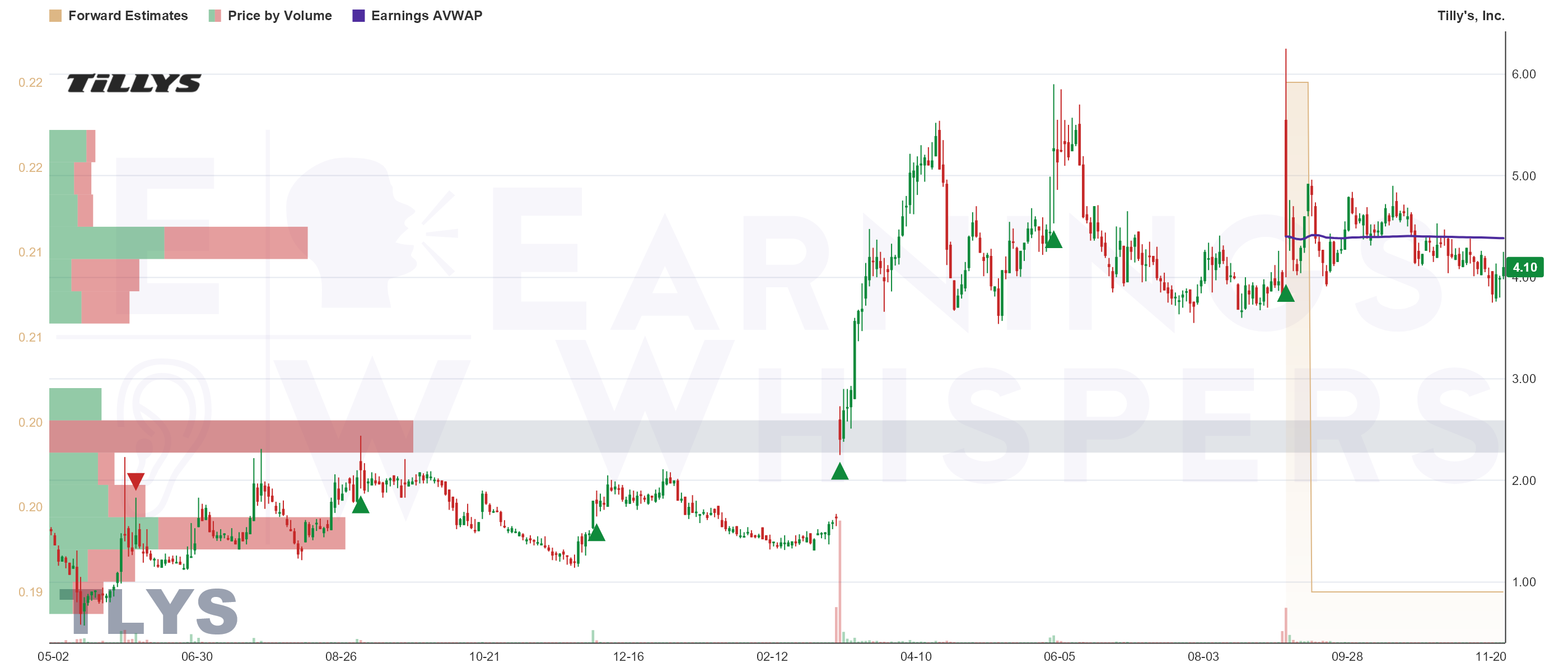
Tilly's (TLYS) steps into the earnings spotlight on Wednesday, December 2, 2026 at about 4:05 PM ET, with Wall Street looking for $0.09 per share on $152.50 million in revenue, a healthy 9.3% jump from a year ago. That lands right in the middle of the company's own guidance of $0.07 to $0.12 per share on $150.00 million to $155.00 million. Investors are feeling upbeat going in, but nobody is expecting fireworks, just a solid in-line print. Short sellers have backed off a touch, down 1.0% since last quarter, while the stock has slid 26.1% from where it opened after the last report, leaving it just 3.1% above its 200 day average of $3.98. Analysts have trimmed their estimates a bit lately, and with shares swinging an average of 16.5% after recent reports, buckle up.
Here is the real story: this scrappy teen retailer has staged a genuine comeback. Last quarter it posted its first profitable trailing year since 2022, with comparable sales up 12.1% and August sales accelerating to 14.6%, marking the 13th straight month of growth. Margins are climbing, the balance sheet is debt-free with $62.2 million in cash, and management has flipped from closing stores to opening 5 to 8 new ones next year, while leaning into TikTok Shop, AI inventory tools, and RFID. The one thing to watch is that sales growth is naturally cooling off as the easy comparisons fade, and history shows a seasonal slowdown after back-to-school. Still, the momentum is real and broad, so the question is less whether Tilly's is winning and more by how much.
AI Gold Rush Powers Tech Giants While the Shopper Comes Roaring Back
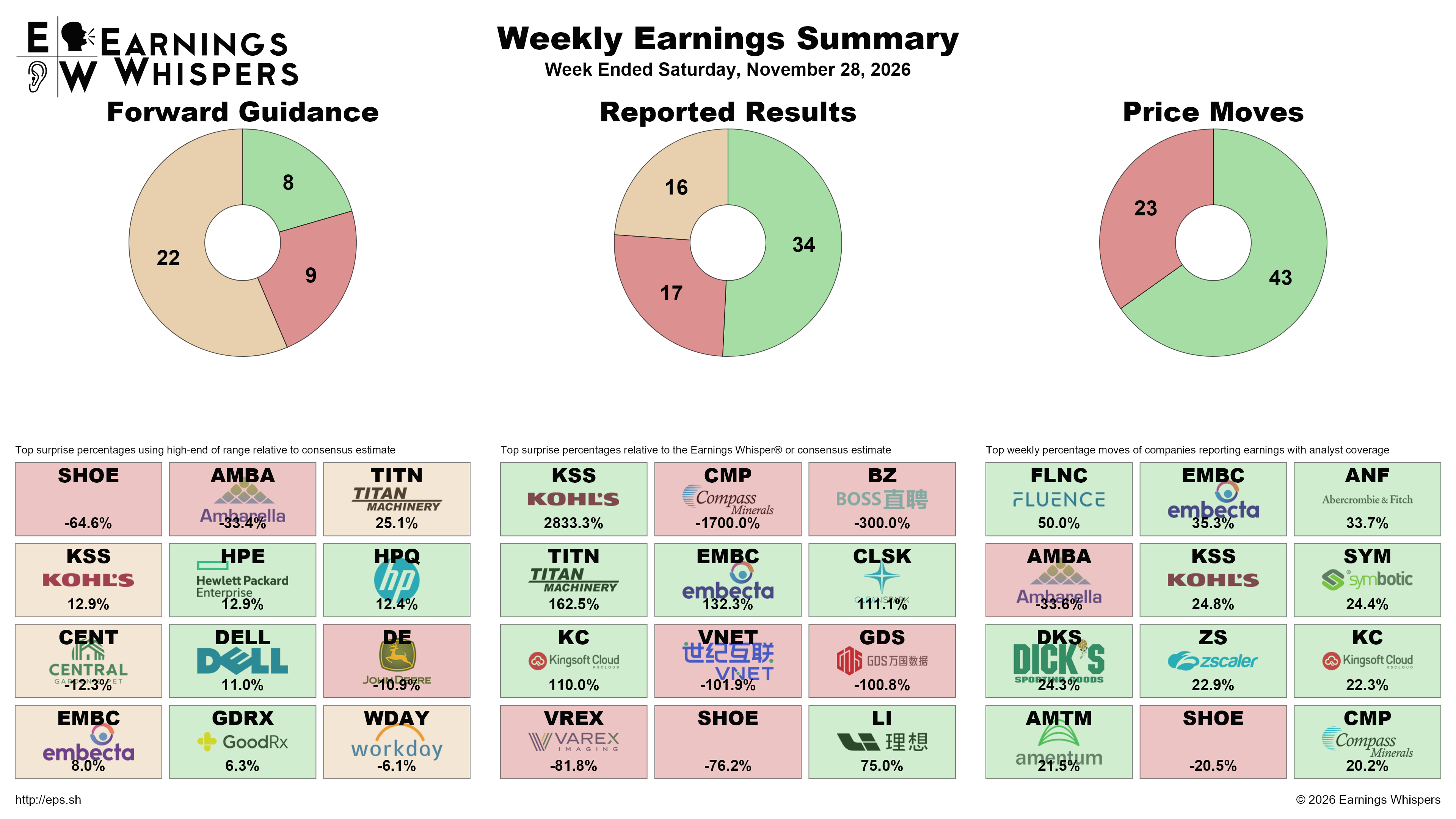
If there was one phrase echoing through earnings calls last week, it was "we can't make enough of it." The biggest story belonged to the hardware makers racing to feed the artificial intelligence boom. Dell stunned Wall Street with a 103% revenue surge and an eye-popping $132 billion backlog of AI server orders, lifting its outlook for the third straight quarter and juicing its stock 14%. Hewlett Packard Enterprise sang a similar tune, rocketing its full-year forecast far above what it had promised just three months earlier on the back of exploding AI demand and a billion-dollar networking win. Even chipmaker Analog Devices joined the party, nearly doubling its spending plans to build new capacity because it is simply too confident in future demand. The catch running beneath all this euphoria is a widening gap between what customers want and what suppliers can deliver, with memory chips and components so scarce the shortage could stretch into 2028. That squeeze showed up most painfully at HP, where a softening market for ordinary PCs and pricier memory chips forced a cautious outlook and a deeper profit dip than planned, a reminder that the same boom lifting servers is pinching the humble laptop.
Away from the data center, the American shopper staged a comeback that few saw coming. Best Buy posted its strongest sales growth in five years and raised its forecast for a third consecutive quarter as televisions and appliances flew off the shelves. The real jaw-dropper was Kohl's, long written off for dead, which returned to positive sales, saw its stock jump 25%, and sharply boosted its outlook, though sharp-eyed readers should note much of that earnings beat came from one-time tax and real estate windfalls rather than the register. Dollar Tree and Dick's Sporting Goods also nudged their guidance higher, riding steady customer traffic. Not every name shared in the cheer. Medical device maker Medtronic delivered a steady but unremarkable quarter, with growth clearly cooling into the next period, while engineering firm Jacobs closed a record year yet watched its backlog slip and its growth pace normalize. The common thread across the winners, whether selling AI servers or holiday gifts, was momentum building faster than expected. The nagging worry everywhere was the same: supply chains, rising costs, and the tricky question of whether this pace can possibly last.
Dell's AI Server Rocket Ship Blasts Past Estimates, PCs Left on the Launchpad
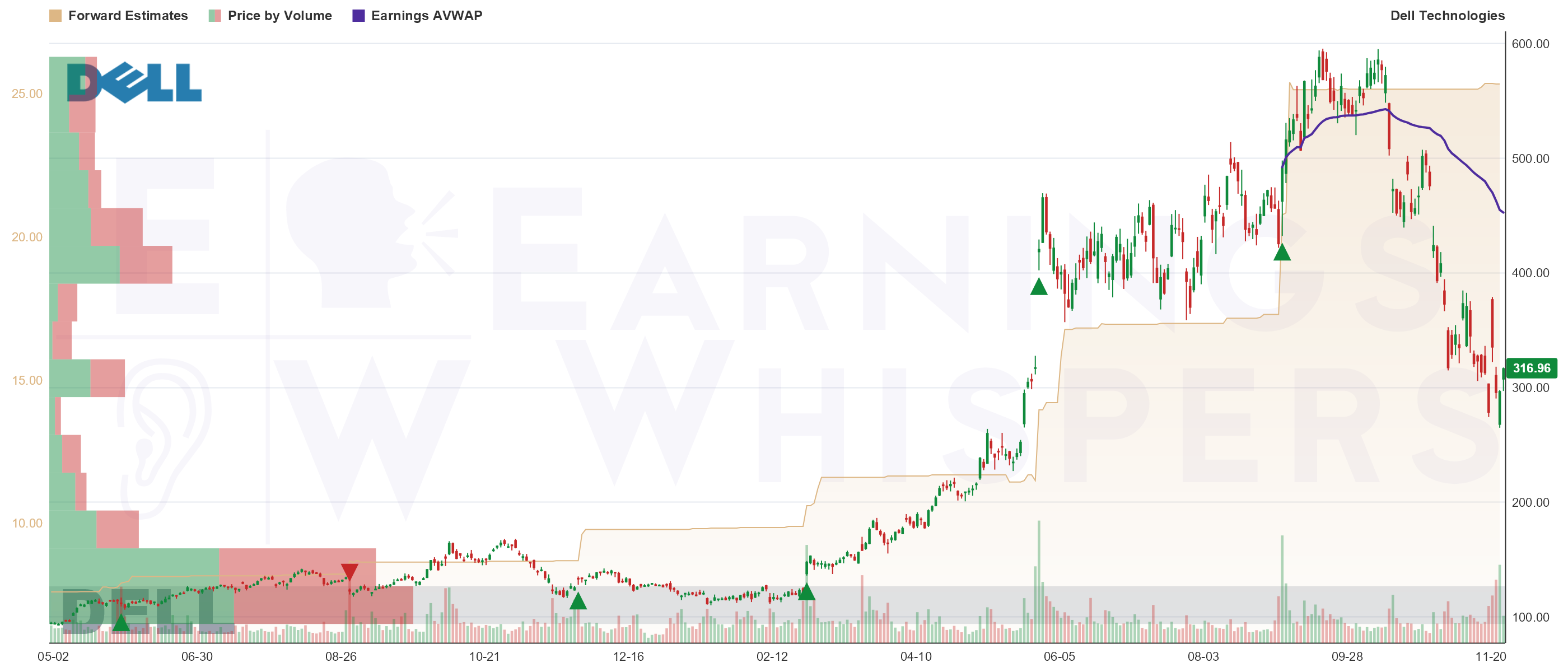
Dell Technologies (DELL) crushed it, posting earnings of $9.45 per share on revenue of $54.94 billion. Wall Street was looking for just $6.77 per share on $50.63 billion, and the whisper number of $7.25 never stood a chance. That is a 30% earnings beat, and revenue more than doubled from a year ago, up a jaw-dropping 103%. Looking ahead, Dell expects fourth quarter earnings of about $8.40 per share on roughly $56.3 billion in revenue, comfortably ahead of the $7.57 and $55.7 billion analysts had penciled in for the quarter ending January 31, 2027. For a company that helps businesses and people build their digital future, the future is clearly arriving fast.
The real story here is artificial intelligence. Dell's AI server order backlog hit a record $132.3 billion, up from $95 billion just last quarter, as companies scramble to get their hands on the next wave of NVIDIA chips. Management bumped up its full-year forecasts for the third straight time and said demand will outrun supply even more in 2027 than this year, with not a single customer canceling orders. The one soft spot is the plain old PC business, where growth slowed to a crawl at 3% as buyers hold off on refreshes. But with the data center division now driving about 83% of operating profit, that sleepy PC market is a small price to pay for riding the AI wave.
HPE Goes Full Throttle on AI, Raises the Bar Again
Hewlett Packard Enterprise (HPE) just closed out its fiscal year with a bang, posting earnings of $1.43 per share on revenue of $14.55 billion. Wall Street was looking for $1.29 per share on $14.45 billion, and the so-called Earnings Whisper number was $1.36, so HPE cleared every bar in the room, beating by about 5% while revenue rocketed up a jaw-dropping 50% from a year ago. Looking ahead, the company expects first quarter earnings of $1.30 to $1.40 per share on revenue of $14.0 to $14.6 billion, well north of the $1.10 and $13.1 billion the Street had penciled in. For the full fiscal 2027, HPE sees $5.05 to $5.35 per share on $59.4 to $63.1 billion in revenue, again blowing past the $4.74 and $55.1 billion consensus. CEO Antonio Neri called fiscal 2026 a defining year, saying HPE built a new networking leader and became a fundamentally different company with greater earnings power and a portfolio built for the next phase of AI. In plain English, HPE is the edge-to-cloud company that helps businesses squeeze value out of their data wherever it lives.
Here is the real story: this is the third call in a row where management hiked its outlook, and this time it was a big one. AI is the engine. AI systems orders hit $4.5 billion in the quarter, more than doubling, and networking-for-AI orders jumped to $1.2 billion. They even folded in the new AMD Helios ramp and landed a billion-dollar-plus win with cloud provider Vultr. Add a 19% dividend bump and roughly $3 billion in buybacks and shareholders have plenty to smile about. The one wrinkle to watch is margins. Gross margin slipped to 38% from 40% and is expected to keep easing as pricier AI servers fill the mix and memory shortages drag on into late 2028. Bottom line, the growth is loud and the orders are piling up, but the profit per dollar gets a little thinner as HPE rides the AI wave.
Zscaler Beats, and Growth Still Has Pep in Its Step
Zscaler (ZS) just posted a clean beat for its fiscal first quarter ended October 2026, ringing up $1.23 per share on revenue of $949.33 million. Wall Street was looking for $1.16 per share on $937.56 million, and even the whisper crowd only wanted $1.18, so the company topped the bottom line by 4.24% and sailed past the top line too. Revenue grew a healthy 20.46% from a year ago, which tells you demand for their security platform is far from cooling off.
The simple story here is that Zscaler keeps selling businesses on moving to the cloud safely, helping them run leaner, faster, and with fewer headaches. Twenty percent growth at this size is no small feat, and the double beat shows management still knows how to set the bar low and clear it with room to spare. We like what we see and would stay in the seat.
DICK'S Beats Big, But the Foot Locker Bet Still Pinches
DICK'S Sporting Goods (DKS) knocked the ball out of the park this quarter, posting earnings of $1.94 per share on revenue of $5.13 billion. Wall Street had only penciled in $1.38 per share on $5.06 billion, and the so-called Earnings Whisper number sat at $1.46, so this was a clean beat of nearly 33 percent while revenue jumped a hefty 23 percent from a year ago. Management also nudged its full-year outlook higher, now guiding to non-GAAP earnings of $11.45 to $12.30 per share on revenue of $22.0 billion to $22.2 billion, up from the prior call for $11.00 to $12.00 per share. For context, the Street was looking for $11.67 on $22.0 billion. DICK'S remains the full-line sporting goods retailer selling brand name gear, apparel, and footwear in a specialty store setting.
Here is the real story, though. This is a steadying quarter, not a comeback sprint. The core DICK'S business is humming and management bought back a mountain of stock, scooping up 6.7 million shares for $903 million and funding it with $1 billion in fresh debt, which is a big reason the per-share number looks so shiny. But same-store sales growth has cooled for three straight quarters, a warm October chilled cold-weather sales, and the newly acquired Foot Locker is still bleeding, posting a $40.9 million operating loss with inventory piled up 15.8 percent. Worse, the boss admits the Foot Locker road is bumpier than expected, with a Nike Jordan supply shakeup set to sting in 2027. Translation: DICK'S is winning, Foot Locker is a fixer-upper, and patience will be required.
Best Buy Finds Its Groove With Best Comp in Five Years
Best Buy just dropped a quarter that actually sparkles. The electronics retailer earned $1.62 per share on $10.24 billion in revenue, blowing past the $1.48 consensus and the $1.53 whisper number while revenue climbed almost 6% from a year ago. Even better, management raised its full-year outlook for the third straight time, now guiding to non-GAAP earnings of $6.90 to $7.05 per share on revenue of $43.0 to $43.3 billion, up from the prior $6.70 to $6.90 and $42.3 to $42.8 billion. Translation: the TV, laptop, and appliance folks are selling a lot more stuff and feeling good about it.
The real story here is that the new CEO and CFO are hitting the ground running. Same-store sales jumped 6.1%, the best in five years, and the growth is broadening out, with TVs and appliances posting their second straight quarter higher. New bets are everywhere, from a TikTok Shop and checkout inside ChatGPT and Gemini to a booming marketplace and a business unit growing around 20%. The catch for next year is that some of this quarter's shine came from one-time tariff refunds that will not repeat, plus a big jump in employee bonus pay, so keep an eye on the March long-term plan for the next real test.
Retail and the dinner-and-shopping crowd offer a friendlier storyline, which is fitting with the holidays bearing down on us. Dollar General and Kroger look like the steady hands of the bunch, with upbeat vibes suggesting shoppers are still filling their carts even while pinching pennies. Victoria's Secret and American Outdoor Brands are quietly generating buzz, and even Cracker Barrel could surprise after a rocky stretch. The big banks up north, including Royal Bank of Canada, Toronto-Dominion, and Bank of Nova Scotia, round things out as the dependable blue-chip bookends, rarely prone to drama but worth watching for clues about the broader economy. The wild cards remain the smaller, more volatile players like Canadian Solar and ChargePoint, where expectations are muted and the potential for a jolt is high. All told, it is a feast for anyone who likes their market news with a side of suspense.
Marvell's AI Rocket Keeps Climbing, But Bears Are Circling
Marvell Technology (MRVL) is set to report earnings on Tuesday, December 1, 2026 at about 4:05 PM ET. Wall Street is looking for $1.10 per share on revenue of $3.16 billion, a hefty 52.3% jump from a year ago, while the Earnings Whisper number sits a touch higher at $1.14. That lands right in the fat part of management's own guidance of $1.05 to $1.15 per share on $2.99 billion to $3.31 billion in sales. Here is the odd part: investors are actually bearish heading in, yet 84.6% still expect a beat. Short sellers have piled on, with short interest up 15.3% since last quarter, and the stock has been in a rough patch, sliding 37.6% from where it opened after the last report and now sitting 25.7% below its 200 day average of $189.17. Still, analysts have been nudging their estimates higher. Option traders are bracing for a 14.3% swing, bigger than the 10.6% average move lately, and on Friday, November 13, there was chunky buying of 16,069 of the $220 calls and 13,829 of the $145 puts expiring January 15, meaning folks are placing big bets in both directions.
Here is why the bearish mood feels out of step with the story. Last quarter Marvell raised its full year revenue target again to roughly $12 billion, the latest in a steady string of hikes, and bumped next year's growth outlook to about 50% even off a bigger base. The headline grabber was a massive expanded deal and warrant with a major hyperscaler in the Google TPU world, framed at around $120 billion in potential revenue over about six and a half years. Custom silicon is expected to more than double next year, operating margins are climbing toward the 38 to 40% target, and the optics business got a big upgrade. The watch items are minor by comparison: the comms segment is lumpy and guided lower near term, custom work is pinching gross margins a bit, and there is a CFO changeover to digest. Net read, the engine is running hot and the bears may be fighting the wrong tape.
Okta Heads Into Earnings Hot, With AI Still Waiting in the Wings
Okta (OKTA) steps up to the plate Tuesday, December 1, 2026 at around 4:00 PM ET. Wall Street is looking for $0.93 per share on $815.52 million in revenue, which would be 9.9% growth from a year ago, but the Earnings Whisper number is a loftier $1.03. Management told us to expect $0.92 to $0.94 per share on revenue between $813 million and $817 million, so they left themselves a little wiggle room to shine. The crowd is feeling good, with 85.7% betting on a beat. Short sellers nudged up their positions by 4.7% since last quarter, yet the stock has shrugged them off and climbed 24.9% since the last report, now sitting a towering 55.1% above its 200 day average of $133.76. Estimates have been drifting higher, option traders are bracing for a 16.5% swing (the stock has averaged a 15.5% jump lately), and on November 11 someone scooped up 2,025 of the $150 puts expiring February 19, 2027, which is worth keeping one eye on.
Here is the real story heading in. Okta is genuinely speeding up, not just coasting. Last quarter they bumped their full-year growth guide to 10-11%, raised free cash flow margins, and guided future bookings higher, all driven by the boring but beautiful core business: big enterprise deals, new products now making up about 30% of bookings, and partner-sourced wins. Customers paying over a million bucks a year grew more than 20% to over 600. The flashy AI and agentic identity stuff (the Permiso buy, the Anthropic partnership, the government IL-5 clearance) is piling up deals but is still too small to move the numbers, so think of it as a lottery ticket for 2028, not a check that clears today. Watch the bookings and the forward guide. If those keep accelerating, the bulls stay happy even before AI ever shows up on the scoreboard.
Snowflake Heads Into Earnings With AI Firing on All Cylinders
Snowflake (SNOW) is set to report earnings after the closing bell on Wednesday, December 2, 2026 at about 4:05 PM ET. Wall Street is looking for $0.60 per share on revenue of $1.65 billion, which would be a healthy 36.0% jump from a year ago, but the whisper number is running hotter at $0.67 per share. That tops the company's own guidance of around $1.59 billion. The crowd is feeling good here, with 88.2% expecting a beat. Short sellers have backed off by 6.7% since last quarter, yet the stock has slid 26.8% from where it opened after the last report, leaving it 12.1% above its 200 day average of $246.54. Analysts have been nudging their estimates higher. Options traders are bracing for a big 14.9% swing, roughly in line with the 16.7% average move of recent quarters, and on Monday, November 16, someone scooped up 3,511 of the $320.00 calls expiring December 18, a clear bet that the fireworks point up.
The story going in is simple: AI has stopped being a science project and become a real growth engine. Last quarter product revenue grew 37%, the third straight pickup, and management raised its full-year outlook yet again while profit margins climbed to 15%. Their AI tools are spreading fast, with Coco now in more than 9,100 accounts and the newer CoWork product already landing in 5,800. Even better, the plain old core business is speeding back up too. The one wrinkle to watch is gross margin, trimmed slightly to 74% because those AI workloads cost more to run, but that is a good problem born of demand, not weakness. If the core keeps re-accelerating alongside AI, the recent slide in the stock may start to look like a gift.
Credo's Rocket Ride Meets a Nervous Crowd
Credo Technology Group Holding (CRDO) steps up to the plate after the close on Tuesday, December 1, 2026 at roughly 4:05 PM ET. Wall Street is looking for $1.29 per share on $530.04 million in revenue, which would be a jaw-dropping 97.8% jump from a year ago, though the whisper number is a touch higher at $1.39. Management itself guided to $525 to $535 million, so they are playing in the same ballpark. Here is the odd part: investors are bearish heading in, yet 68.8% still expect a beat. Short sellers have piled on, with short interest up 43.7% since last quarter, and the stock has tumbled 38.7% from where it opened after the last report, leaving it a stunning 36.0% below its 200 day average of $180.54. Still, estimates have been drifting higher, not lower. Option traders are bracing for a 19.0% swing, bigger than the 11.4% average move of late, and on Friday someone scooped up 4,138 of the $140 calls expiring in October 2027, a sizable bet that the gloom is overdone.
The story under the hood is all about optics finally becoming a real second engine. Last quarter Credo raised its full-year growth guide yet again, to over 85%, posted a record quarter, and recognized its first silicon photonics revenue after the Dust Photonics deal. New wins keep stacking up, from joining the OpenCPX consortium to design wins ramping in 2028 and 1.6T chips landing later this year. The catch is that the back half of the year leans heavily on an unproven optics ramp, gross margins are flat rather than climbing, and cash dropped from $1.4 billion to $764 million after the Dust buyout. Two customers still make up more than half of sales. So the engine is roaring, but the market clearly wants proof the second half delivers before it climbs back on board.
MongoDB Heads Into Earnings Hot, But the Stock Didn't Get the Memo
MongoDB (MDB) steps up to the plate after the close on Tuesday, December 1, 2026, at roughly 4:05 PM ET. Wall Street wants $1.60 per share on $759.63 million in revenue, which would be a tidy 20.9% jump from a year ago, but the whisper number is running hotter at $1.79. Management penciled in $1.57 to $1.61 per share on $756 to $761 million. The crowd is feeling good here, with 83.3% betting on a beat, and short sellers have backed off by 5.5% since last quarter. Still, the stock has quietly slid 15.6% since its last earnings pop and now sits 3.7% under its 200 day average of $332.26. Analysts have nudged estimates higher. Options traders are bracing for a 16.8% swing, roughly in line with the 18.6% average lately, and someone made a bold long-term bet on Friday, November 13, scooping up 3,414 of the $600 calls that expire in December 2028.
Here is the real story: last quarter was a barnburner. Total revenue growth sped up to 30%, the fastest since fiscal 2024, and management raised guidance on basically every line, lifting the Atlas growth outlook by 300 basis points and pushing margins up. The surprise star was the self-managed EA business, posting its first double-digit full-year growth in three years after search and vector search launched there. Add in a fresh Anthropic partnership plugging Claude into the mix, AI shops shifting workloads off Postgres onto Atlas, and Voyage customer counts nearly doubling for a second straight quarter, and you have real momentum. The one nitpick is a cautious fourth-quarter Atlas setup, which management chalks up to being conservative rather than any actual slowdown. With a cheaper stock and raised numbers, this one is worth watching closely.
Salesforce: The AI Agents Are Actually Selling Now
Salesforce reports after the bell on Wednesday, December 2, 2026, and Wall Street wants $3.43 a share on $11.46 billion in sales, which would be about 11.7% more revenue than a year ago. The quiet number the pros whisper about is a bit higher at $3.65, and the company itself guided to $3.42 to $3.44 on $11.42 to $11.50 billion. Here is the funny part: investors are walking in grumpy and bearish, yet 72.7% of them still expect a beat. Short sellers have backed off, cutting their bets by 16.4% since last quarter, while the stock has slid 13.8% from where it opened after the last report and now sits a hair (0.2%) above its 200 day average of $197.75. Analysts have been nudging estimates higher, option traders are bracing for a roughly 11% swing even though the stock usually moves about 6.5%, and on November 17 someone scooped up 14,279 of the $150 puts expiring in January, a sizable 'just in case' bet.
Last quarter was the best of the bunch, and that raises the bar. Salesforce bumped up its full year revenue outlook, its booked-but-not-yet-recognized backlog accelerated to 14% growth, and the AI story kept compounding fast. AgentForce, its army of AI helpers, nearly tripled its recurring revenue over three quarters to $1.5 billion, cash flow jumped 81%, and management flat out said a second half pickup is now just 'math.' The catch to watch this time: profit margins have stayed stuck at about 34.3% for a full year, a fresh $100 million currency headwind is biting, part of that guidance raise came from acquisitions rather than organic muscle, and the old soft spots in Tableau and commerce are still dragging. Translation for Wednesday: the growth engine looks real, so the market will be hunting for proof the profits and organic momentum can keep up.
Macy's Walks Into Earnings With Wind at Its Back
Macy's (M) is set to report earnings on Wednesday, December 2, 2026 at roughly 6:55 AM ET. Wall Street is bracing for a loss of $0.16 per share on revenue of $4.71 billion, down 4.1% from a year ago, though the Earnings Whisper number is a slightly better loss of $0.12. Investors are feeling good heading in, with 80% betting on a beat. Short sellers have piled on too, up 10.7% since last quarter, yet the stock has climbed 20.6% since its last report and now sits 11.2% above its 200 day average of $21.96. Estimates have been nudged higher across the board. Options traders are bracing for a 10.2% swing, bigger than the 5.4% average move of late, and on November 17 someone scooped up 1,591 of the $23.50 calls expiring December 4.
Here is the real story: Macy's turnaround is finally showing teeth. Management raised guidance two quarters in a row, something retailers rarely pull off, and Bloomingdale's just posted its best second quarter in 154 years. The old tariff headache has flipped into a tailwind for the back half, padding earnings by about $0.18. The catch is caution. Leadership kept second half sales flat despite the beat, and the Q3 setup is tough, implying a comp anywhere from down 0.5% to up 0.5% against last year's hot +3.2%. Furniture is still soft and the budget shopper is picky. Still, with no cuts, accelerating luxury, and a confident tone, the bulls have a solid case.
NIO's Premium Push Is Working, But the Margin Party Has Stalled
NIO (NIO) steps up to report earnings bright and early on Tuesday, December 1, 2026, at around 6:00 AM ET. Wall Street is looking for a slim loss of just 3 cents per share on revenue of $4.97 billion, which would be a juicy 62.3% jump from a year ago, and that lands right in the middle of the company's own guidance range of $4.91 billion to $5.02 billion. Here's the funny part: investors are feeling gloomy heading in, yet a solid 70% still expect a beat. Short sellers have backed off a bit, trimming their bets by 6.8% since last quarter, but the stock has limped lower by 30.1% since its last earnings reaction and now sits a painful 39.8% below its 200-day average of $4.73. Estimates have been nudged lower across the board. Options traders are bracing for a 14.2% swing, which is chunky compared to the typical 4.6% move lately. One eyebrow-raiser: on November 12, someone scooped up 43,069 of the $2.50 puts expiring in March 2027.
The real story is a tug-of-war. NIO just posted its third straight non-GAAP profitable quarter and finally flipped to positive free cash flow, with cash piling up to RMB56.7 billion. The pricey ES9 flagship is a genuine hit, leading its luxury segment with three-month waits and pulling in mostly brand-new customers, while the ES8 keeps rolling off lots. The catch is that margins have hit a ceiling. Rising chip and raw-material costs are adding roughly RMB16-17k per car, so management only guided vehicle margins flat at about 18.5% with no bump coming. On top of that, the ambitious 50k-a-month sales dream got pushed out to the fuzzy 'mid to long term,' and the cheaper Onvo brand is still struggling to get noticed. Bottom line: the profit story is real, but don't expect fireworks on margins.
DocuSign Heads Into Earnings With the Bears Looking Cornered
DocuSign (DOCU) steps up to the plate Thursday, December 3, 2026 at about 4:05 PM ET. Wall Street is looking for $1.17 per share on $888.69 million in revenue, which would be 8.6% growth from a year ago, but the whisper number is a juicier $1.23. The company itself guided for $886 to $890 million, so the bar is well marked. Here is the funny part: investors are feeling bearish going in, yet 77.8% of them still expect a beat, which is a bit like booing the home team while betting on them. Short sellers have been quietly heading for the exits, with short interest down 25.4% since last quarter, while the stock has climbed 17.8% since its last earnings open and now sits a lofty 41.6% above its 200 day average of $57.02. Estimates have been revised higher, option traders are bracing for a 12.0% swing versus the 7.5% average of recent quarters, and on November 20 someone scooped up 4,245 of the $69.00 puts expiring December 4, so not everyone is convinced the party continues.
The real story here is IAM, DocuSign's newer intelligent agreement platform, which is growing faster than management planned. Last quarter it hit 15.1% of total recurring revenue, up from 12.6% just three months earlier, and the company raised its guidance across the board on full-year recurring revenue growth, revenue, margins, and IAM mix. That is three straight margin raises and a tone that got noticeably more confident. They are landing big names like Salesforce and Oppenheimer and rolling out AI agents that cut contract review time in half. The things to watch: gross margins are still slightly pressured by a cloud migration wrapping up by year end, and the shiny new AI connector stuff is not making real money yet. But with momentum building and a crowd that is bearish in mood but bullish in bets, this one is worth watching closely.
Rubrik Rides a Winning Streak Into Earnings
Rubrik (RBRK) steps up to the plate on Monday, November 30, 2026 at around 4:05 PM ET. Wall Street is looking for $0.08 per share on revenue of $430.96 million, which would mark a healthy 23.1% jump in sales from a year ago, but the Earnings Whisper number is more ambitious at $0.19 per share. The company itself guided for $0.07 to $0.09 on revenue between $429 million and $431 million. Investors are leaning bearish heading in, though it's basically a coin flip with half of them still betting on a beat. Short sellers have been backing off, cutting their positions by 16.2% since last quarter, while the stock has quietly climbed 14.1% since that last report and now sits a lofty 39.4% above its 200 day moving average of $81.00. Analysts have been trimming estimates lately, so expectations have cooled a bit. Options traders are bracing for a 14.8% swing, which is bigger than the 10.0% average move of recent quarters, and one trader made a splash on November 16 by scooping up 1,000 of the $180.00 puts expiring way out in January 2029.
Here's the real story: this company has beaten expectations ten quarters in a row, and last quarter was its best showing yet. Its recurring subscription business grew 33% to $1.66 billion, management actually used the word "accelerated," and they raised their full-year targets for profit, margins, and cash flow for the second straight time. On top of that, they've got free bonus potential from new products like Strata, Flex, and their security tools that aren't even counted in the forecast. The one thing to keep an eye on is that management is penciling in a sharp slowdown for the back half of the year, but they chalk that up to playing it safe rather than any real drop in demand. If this crew keeps doing what it's been doing, the bears may be in for a rough afternoon.
Tilly's Turnaround Finds Its Footing Ahead of Q2
Tilly's (TLYS) steps into the earnings spotlight on Wednesday, December 2, 2026 at about 4:05 PM ET, with Wall Street looking for $0.09 per share on $152.50 million in revenue, a healthy 9.3% jump from a year ago. That lands right in the middle of the company's own guidance of $0.07 to $0.12 per share on $150.00 million to $155.00 million. Investors are feeling upbeat going in, but nobody is expecting fireworks, just a solid in-line print. Short sellers have backed off a touch, down 1.0% since last quarter, while the stock has slid 26.1% from where it opened after the last report, leaving it just 3.1% above its 200 day average of $3.98. Analysts have trimmed their estimates a bit lately, and with shares swinging an average of 16.5% after recent reports, buckle up.
Here is the real story: this scrappy teen retailer has staged a genuine comeback. Last quarter it posted its first profitable trailing year since 2022, with comparable sales up 12.1% and August sales accelerating to 14.6%, marking the 13th straight month of growth. Margins are climbing, the balance sheet is debt-free with $62.2 million in cash, and management has flipped from closing stores to opening 5 to 8 new ones next year, while leaning into TikTok Shop, AI inventory tools, and RFID. The one thing to watch is that sales growth is naturally cooling off as the easy comparisons fade, and history shows a seasonal slowdown after back-to-school. Still, the momentum is real and broad, so the question is less whether Tilly's is winning and more by how much.
AI Gold Rush Powers Tech Giants While the Shopper Comes Roaring Back
If there was one phrase echoing through earnings calls last week, it was "we can't make enough of it." The biggest story belonged to the hardware makers racing to feed the artificial intelligence boom. Dell stunned Wall Street with a 103% revenue surge and an eye-popping $132 billion backlog of AI server orders, lifting its outlook for the third straight quarter and juicing its stock 14%. Hewlett Packard Enterprise sang a similar tune, rocketing its full-year forecast far above what it had promised just three months earlier on the back of exploding AI demand and a billion-dollar networking win. Even chipmaker Analog Devices joined the party, nearly doubling its spending plans to build new capacity because it is simply too confident in future demand. The catch running beneath all this euphoria is a widening gap between what customers want and what suppliers can deliver, with memory chips and components so scarce the shortage could stretch into 2028. That squeeze showed up most painfully at HP, where a softening market for ordinary PCs and pricier memory chips forced a cautious outlook and a deeper profit dip than planned, a reminder that the same boom lifting servers is pinching the humble laptop.
Away from the data center, the American shopper staged a comeback that few saw coming. Best Buy posted its strongest sales growth in five years and raised its forecast for a third consecutive quarter as televisions and appliances flew off the shelves. The real jaw-dropper was Kohl's, long written off for dead, which returned to positive sales, saw its stock jump 25%, and sharply boosted its outlook, though sharp-eyed readers should note much of that earnings beat came from one-time tax and real estate windfalls rather than the register. Dollar Tree and Dick's Sporting Goods also nudged their guidance higher, riding steady customer traffic. Not every name shared in the cheer. Medical device maker Medtronic delivered a steady but unremarkable quarter, with growth clearly cooling into the next period, while engineering firm Jacobs closed a record year yet watched its backlog slip and its growth pace normalize. The common thread across the winners, whether selling AI servers or holiday gifts, was momentum building faster than expected. The nagging worry everywhere was the same: supply chains, rising costs, and the tricky question of whether this pace can possibly last.
Dell's AI Server Rocket Ship Blasts Past Estimates, PCs Left on the Launchpad
Dell Technologies (DELL) crushed it, posting earnings of $9.45 per share on revenue of $54.94 billion. Wall Street was looking for just $6.77 per share on $50.63 billion, and the whisper number of $7.25 never stood a chance. That is a 30% earnings beat, and revenue more than doubled from a year ago, up a jaw-dropping 103%. Looking ahead, Dell expects fourth quarter earnings of about $8.40 per share on roughly $56.3 billion in revenue, comfortably ahead of the $7.57 and $55.7 billion analysts had penciled in for the quarter ending January 31, 2027. For a company that helps businesses and people build their digital future, the future is clearly arriving fast.
The real story here is artificial intelligence. Dell's AI server order backlog hit a record $132.3 billion, up from $95 billion just last quarter, as companies scramble to get their hands on the next wave of NVIDIA chips. Management bumped up its full-year forecasts for the third straight time and said demand will outrun supply even more in 2027 than this year, with not a single customer canceling orders. The one soft spot is the plain old PC business, where growth slowed to a crawl at 3% as buyers hold off on refreshes. But with the data center division now driving about 83% of operating profit, that sleepy PC market is a small price to pay for riding the AI wave.
HPE Goes Full Throttle on AI, Raises the Bar Again
Hewlett Packard Enterprise (HPE) just closed out its fiscal year with a bang, posting earnings of $1.43 per share on revenue of $14.55 billion. Wall Street was looking for $1.29 per share on $14.45 billion, and the so-called Earnings Whisper number was $1.36, so HPE cleared every bar in the room, beating by about 5% while revenue rocketed up a jaw-dropping 50% from a year ago. Looking ahead, the company expects first quarter earnings of $1.30 to $1.40 per share on revenue of $14.0 to $14.6 billion, well north of the $1.10 and $13.1 billion the Street had penciled in. For the full fiscal 2027, HPE sees $5.05 to $5.35 per share on $59.4 to $63.1 billion in revenue, again blowing past the $4.74 and $55.1 billion consensus. CEO Antonio Neri called fiscal 2026 a defining year, saying HPE built a new networking leader and became a fundamentally different company with greater earnings power and a portfolio built for the next phase of AI. In plain English, HPE is the edge-to-cloud company that helps businesses squeeze value out of their data wherever it lives.
Here is the real story: this is the third call in a row where management hiked its outlook, and this time it was a big one. AI is the engine. AI systems orders hit $4.5 billion in the quarter, more than doubling, and networking-for-AI orders jumped to $1.2 billion. They even folded in the new AMD Helios ramp and landed a billion-dollar-plus win with cloud provider Vultr. Add a 19% dividend bump and roughly $3 billion in buybacks and shareholders have plenty to smile about. The one wrinkle to watch is margins. Gross margin slipped to 38% from 40% and is expected to keep easing as pricier AI servers fill the mix and memory shortages drag on into late 2028. Bottom line, the growth is loud and the orders are piling up, but the profit per dollar gets a little thinner as HPE rides the AI wave.
Zscaler Beats, and Growth Still Has Pep in Its Step
Zscaler (ZS) just posted a clean beat for its fiscal first quarter ended October 2026, ringing up $1.23 per share on revenue of $949.33 million. Wall Street was looking for $1.16 per share on $937.56 million, and even the whisper crowd only wanted $1.18, so the company topped the bottom line by 4.24% and sailed past the top line too. Revenue grew a healthy 20.46% from a year ago, which tells you demand for their security platform is far from cooling off.
The simple story here is that Zscaler keeps selling businesses on moving to the cloud safely, helping them run leaner, faster, and with fewer headaches. Twenty percent growth at this size is no small feat, and the double beat shows management still knows how to set the bar low and clear it with room to spare. We like what we see and would stay in the seat.
DICK'S Beats Big, But the Foot Locker Bet Still Pinches
DICK'S Sporting Goods (DKS) knocked the ball out of the park this quarter, posting earnings of $1.94 per share on revenue of $5.13 billion. Wall Street had only penciled in $1.38 per share on $5.06 billion, and the so-called Earnings Whisper number sat at $1.46, so this was a clean beat of nearly 33 percent while revenue jumped a hefty 23 percent from a year ago. Management also nudged its full-year outlook higher, now guiding to non-GAAP earnings of $11.45 to $12.30 per share on revenue of $22.0 billion to $22.2 billion, up from the prior call for $11.00 to $12.00 per share. For context, the Street was looking for $11.67 on $22.0 billion. DICK'S remains the full-line sporting goods retailer selling brand name gear, apparel, and footwear in a specialty store setting.
Here is the real story, though. This is a steadying quarter, not a comeback sprint. The core DICK'S business is humming and management bought back a mountain of stock, scooping up 6.7 million shares for $903 million and funding it with $1 billion in fresh debt, which is a big reason the per-share number looks so shiny. But same-store sales growth has cooled for three straight quarters, a warm October chilled cold-weather sales, and the newly acquired Foot Locker is still bleeding, posting a $40.9 million operating loss with inventory piled up 15.8 percent. Worse, the boss admits the Foot Locker road is bumpier than expected, with a Nike Jordan supply shakeup set to sting in 2027. Translation: DICK'S is winning, Foot Locker is a fixer-upper, and patience will be required.
Best Buy Finds Its Groove With Best Comp in Five Years
Best Buy just dropped a quarter that actually sparkles. The electronics retailer earned $1.62 per share on $10.24 billion in revenue, blowing past the $1.48 consensus and the $1.53 whisper number while revenue climbed almost 6% from a year ago. Even better, management raised its full-year outlook for the third straight time, now guiding to non-GAAP earnings of $6.90 to $7.05 per share on revenue of $43.0 to $43.3 billion, up from the prior $6.70 to $6.90 and $42.3 to $42.8 billion. Translation: the TV, laptop, and appliance folks are selling a lot more stuff and feeling good about it.
The real story here is that the new CEO and CFO are hitting the ground running. Same-store sales jumped 6.1%, the best in five years, and the growth is broadening out, with TVs and appliances posting their second straight quarter higher. New bets are everywhere, from a TikTok Shop and checkout inside ChatGPT and Gemini to a booming marketplace and a business unit growing around 20%. The catch for next year is that some of this quarter's shine came from one-time tariff refunds that will not repeat, plus a big jump in employee bonus pay, so keep an eye on the March long-term plan for the next real test.